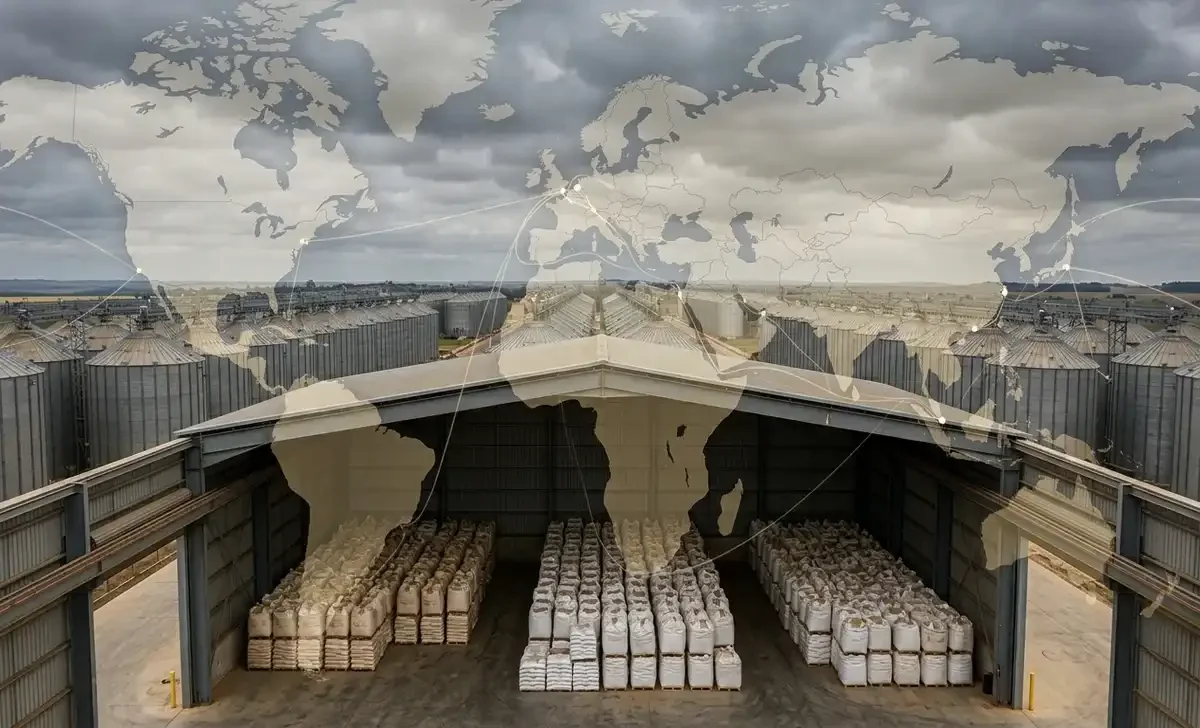
Walk into any agricultural policy briefing today, and you'll hear the same concern raised again and again — China hoarding food and fertiliser is quietly destabilising global markets in ways most people haven't fully grasped yet.
China now holds the world's largest strategic reserves of grain, pork, and key fertiliser inputs. While Beijing frames this as responsible food security planning, the downstream effects are being felt everywhere — from wheat prices in North Africa to ammonia availability in South Asia. Farmers, traders, and policymakers on every continent are watching closely.
In this article, we'll break down exactly what China is stockpiling and why, how it affects global food and fertiliser markets, and what the rest of the world should be thinking about right now.
1. Why China Started Stockpiling in the First Place
China's stockpiling behaviour didn't emerge overnight. It accelerated sharply after a series of shocks — severe flooding in 2020 that damaged domestic crops, the COVID-19 pandemic exposing fragile global supply chains, and growing geopolitical friction with the West that raised fears of future trade restrictions.
President Xi Jinping made food self-sufficiency an explicit national priority, publicly warning that "food security is a national priority" and that China must "keep the rice bowl firmly in its own hands." This wasn't just rhetoric. The government backed it up with concrete directives to state-owned enterprises and local governments to aggressively build grain reserves.
China also learned from the 2007–2008 global food crisis, when commodity prices spiked and food riots erupted across more than 30 countries. That moment exposed how quickly global supply chains can break down — and China has been quietly preparing ever since.
Key drivers behind the stockpiling policy:
- Domestic population of 1.4 billion to feed
- Historical trauma from the Great Famine (1959–1961)
- Geopolitical decoupling from Western trade partners
- Climate-related risks to domestic agriculture
2. The Scale of China's Grain Reserves
The numbers here are genuinely staggering. By recent estimates, China holds approximately 65–70% of the world's maize (corn) reserves, over 50% of global wheat stocks, and more than 60% of rice reserves. These figures, drawn from USDA reports and the UN Food and Agriculture Organization, represent holdings far beyond any historical precedent.
To put it in perspective: China has roughly 18% of the world's population but is sitting on the majority of global grain buffers. For wheat alone, its reserves could theoretically feed its entire population for over a year without a single additional import.
This kind of accumulation changes market dynamics in fundamental ways. When China buys heavily from global markets to top up reserves, prices spike. When it stops buying, they fall — and suppliers lose anticipated revenue. Markets that once priced grain based on weather, logistics, and production costs are now increasingly pricing based on what Beijing decides to do next.
3. China's Dominance in Fertiliser Production and Export Controls
Fertiliser might not grab headlines the way grain does, but it's arguably even more critical. No fertiliser, no crops — it's that simple.
China is one of the world's largest producers of phosphate, urea (nitrogen fertiliser), and potash compounds. It accounts for roughly 25–30% of global phosphate exports and a significant share of urea production. In late 2021 and again in subsequent years, China imposed export restrictions on phosphate fertilisers, citing domestic supply needs.
The timing was brutal for global agriculture. Coming alongside Russia's own fertiliser export controls and the Belarus potash disruptions, China's restrictions contributed directly to a global fertiliser price surge that left farmers in Africa, South Asia, and Latin America unable to afford inputs for their fields.
This isn't just an agricultural story — it has deep financial underpinnings too. As analysts have noted when examining how resource concentration creates systemic vulnerabilities, the risks embedded in commodity-linked financial structures can amplify real-economy shocks in ways that aren't always visible until a crisis hits.
China's key fertiliser export restrictions have included:
- Phosphate: export bans introduced in 2021, extended with quotas
- Urea: informal curbs tied to domestic energy and production costs
- NPK compound fertilisers: tighter customs inspection regimes used as a de facto slowdown
4. The Role of Food Security Policy in Chinese Politics
Understanding China's stockpiling requires understanding Chinese domestic politics. Food security isn't just an economic issue in China — it's deeply tied to political legitimacy.
The Communist Party's claim to rule rests in part on its ability to guarantee social stability, and nothing destabilises a society faster than food shortages. The memory of famine is not abstract in China — it's lived history for older generations.
This means food security decisions are made at the highest political levels, often prioritising strategic buffer-building over short-term market efficiency. Local officials are evaluated on grain production and storage targets. Provinces compete to exceed central targets. The system is structurally biased toward accumulation.
Xi's 2022 "No limits" partnership with Russia, signed just before the Ukraine invasion, also raised concerns about whether China's stockpiling was partly anticipatory — a hedge against the possibility that its own international position could become more confrontational and its access to global markets less reliable.
5. How It Affects Global Food Prices
China's buying patterns have become one of the single biggest swing factors in international grain markets. When COFCO (China's state grain trader) and other state-backed buyers enter markets aggressively, prices respond immediately.
This is especially pronounced in markets like soybeans, where China imports enormous volumes from Brazil and the United States. During periods of heavy Chinese buying, futures prices for soybeans, wheat, and corn can rise significantly, affecting food costs for importing nations that have far less purchasing power than Beijing.
For lower-income countries that rely on grain imports to feed their populations, this is not an abstract concern. Bread prices in Egypt, pasta costs in Ethiopia, and tortilla prices in parts of Latin America have all been linked by commodity analysts to fluctuations tied partly to Chinese demand and reserve-building activity.
The indirect effects through animal feed are also substantial. When corn prices rise because China is stockpiling, livestock production costs go up globally, which eventually feeds through to meat, dairy, and egg prices for consumers everywhere.
6. The Fertiliser Supply Crunch — Who Gets Hurt Most?
The countries hit hardest by China's fertiliser export restrictions are precisely the ones least equipped to absorb the blow. Sub-Saharan African nations, South Asian smallholder farmers, and parts of Southeast Asia depend heavily on affordable imported fertilisers.
When phosphate prices tripled in 2021–2022 — partly due to Chinese export controls, partly due to the Russia-Ukraine war disrupting supplies — many smallholder farmers simply stopped applying fertiliser. The result was predictable: lower crop yields, higher food prices, and increased hunger.
The situation also accelerated conversations about resource concentration in commodity markets. It's worth drawing a parallel to what's happening in other sectors: just as the mining sector has seen supply shocks from single-country dominance — a dynamic visible in events like the closure of major mining operations in regions dependent on single commodity exports — fertiliser markets face similar fragility when one nation controls dominant production and can turn the export tap on or off at will.
Nations most vulnerable to China's fertiliser export controls:
- Bangladesh, Pakistan, and India (heavy phosphate importers)
- Brazil (partially, despite domestic production)
- West African agricultural economies
- Indonesia and Vietnam
7. China's Pork Reserves and Animal Feed Implications
Less discussed internationally but equally significant: China operates the world's largest strategic pork reserve. Pork is the most consumed meat in China, accounting for roughly 60% of total meat intake. The government actively buys and releases pork from state reserves to manage domestic prices — a practice with significant knock-on effects globally.
Maintaining pork reserves requires massive amounts of animal feed — primarily corn and soybeans. China's soybean imports alone regularly exceed 90–100 million tonnes per year. This feed demand means China's domestic livestock policy directly drives import volumes that affect prices on the Chicago Board of Trade and São Paulo's B3 exchange.
The African Swine Fever outbreaks that devastated China's pig herds between 2018 and 2020 are instructive. China's subsequent restocking effort drove an extraordinary surge in soybean and corn imports, catching global markets off guard. As herd sizes recover and the government pushes to expand the strategic reserve again, international commodity markets must brace for similar demand spikes.
8. Geopolitical Tensions and the Resource Hoarding Debate
Not everyone uses the word "hoarding" — and that framing is itself contested. Chinese officials insist that building strategic reserves is a rational response to geopolitical uncertainty, not an attempt to corner global markets. They point out that the United States, the European Union, and others also maintain strategic reserves of various commodities.
The counterargument from food security researchers is about proportionality. China's reserves are so large relative to global available stocks that they functionally reduce the buffer available to the rest of the world. In a bad harvest year — say, a drought across North America and South Asia simultaneously — the global food system would have far less slack to absorb the shock because so much grain is held in Chinese state storage.
Tensions around this issue have sharpened amid broader US-China decoupling trends. Washington has raised concerns about Chinese buying of agricultural land in the United States. Several European governments have flagged fertiliser dependency as a strategic vulnerability requiring domestic industrial policy responses.
9. The Global Race to Secure Alternative Supply Chains
The good news — if there is any — is that China's dominance over fertiliser supply has triggered a global investment wave in alternative production.
Morocco (via OCP Group) is expanding phosphate mining and processing capacity dramatically. Canada is developing new potash mines in Saskatchewan. Several African nations are exploring domestic phosphate reserves. India has invested in overseas phosphate assets to reduce import dependence.
On the food side, grain-exporting nations have become more strategic about domestic reserve-building. Brazil continues to expand its agricultural footprint to capture demand from buyers seeking alternatives to dependence on any single nation's exports.
There's a broader lesson here about resilience. The most durable responses to supply concentration often don't involve matching the dominant player's scale — they involve diversifying sources, investing in efficiency, and building alternatives. In that sense, the response to China's food and fertiliser stockpiling parallels approaches seen across industries grappling with single-point-of-failure risks, where finding solutions that don't rely on existing dominant players can unlock surprising resilience.
10. What Other Nations Are Doing in Response
Governments aren't sitting still. Here's how major players are responding:
United States: The USDA has expanded domestic fertiliser production incentives. The White House has flagged food system resilience as a national security priority. There are discussions about strategic grain reserve programs similar to China's, though politically contentious.
European Union: The EU's Farm to Fork strategy includes supply chain resilience measures. Several member states are boosting domestic fertiliser production. The EU is also diversifying away from Russian and Chinese fertiliser imports through import substitution investment.
India: Has built up its own grain reserves aggressively and is investing in fertiliser self-sufficiency. India has also become more assertive about managing its own food exports during shortages, something that mirrors China's approach.
Brazil: Doubling down on agricultural expansion and positioning itself as the world's most reliable alternative supplier of soybeans, corn, and other commodities to buyers wary of concentration risk.
African Union: Is developing the African Continental Free Trade Area partly as a mechanism to build regional food system resilience and reduce dependence on external inputs.
Expert Tips
- Watch COFCO tender announcements closely. When China's state grain trader issues large international purchase tenders, it's often a leading indicator of a reserve top-up cycle — and prices will follow.
- Diversify fertiliser sourcing now, not during a crisis. Farmers and agribusinesses that have pre-established relationships with multiple supplier countries were far less exposed during the 2021–2022 fertiliser price spike.
- Think in terms of multi-year cycles. China's stockpiling behaviour tends to follow predictable political cycles — it accelerates before Party Congresses and major national policy announcements when leaders want to demonstrate control and stability.
- Monitor Chinese domestic production data. When domestic harvests are poor, China enters global markets more aggressively. A good Chinese harvest year typically means reduced buying pressure internationally.
- For policymakers: Food system resilience requires investment before the crisis, not after. The nations that will weather the next supply shock best are those building reserves, diversifying suppliers, and investing in domestic production capacity today.
Common Mistakes to Avoid
Assuming Chinese policy is driven purely by economics. Food and fertiliser stockpiling decisions in China are shaped heavily by political considerations. Standard supply-demand modelling will underestimate both the scale and the timing of Chinese interventions.
Underestimating knock-on effects. Many analysts focus on direct commodity price impacts but miss second and third-order effects — like how a corn price spike flows through to livestock costs, dairy prices, and eventually retail food inflation.
Treating this as a short-term phenomenon. China's strategic reserve-building is a long-term structural policy. Businesses and governments that plan around it as a temporary blip will repeatedly be caught off guard.
Ignoring the fertiliser-food linkage. Fertiliser supply disruptions don't hit food prices immediately — there's a one-to-two growing season lag. Policymakers who wait for food price data before acting on fertiliser signals will always be behind the curve.
Conflating Chinese government buying with Chinese market demand. State stockpiling and genuine consumer demand are different things. Sophisticated commodity traders track both separately.
FAQs
How much food does China actually have stockpiled?
By USDA and FAO estimates, China holds approximately 65–70% of global corn reserves, over 50% of wheat stocks, and around 60% of rice. These are the largest strategic reserves ever accumulated by any nation in modern history.
Why does China need so much fertiliser?
China has enormous domestic agricultural needs — feeding 1.4 billion people requires massive fertiliser inputs. But China is also the world's largest fertiliser producer, particularly of phosphates and urea. Export controls have been used to prioritise domestic supply when prices rise or when geopolitical tensions increase.
Does China's hoarding of food cause global hunger?
The link is indirect but real. When China accumulates large grain reserves through international purchases, it reduces available stocks for other importers, pushes up global prices, and reduces the global buffer available in the event of a widespread crop failure. Lower-income food-importing nations are disproportionately affected.
Is China's stockpiling illegal under international trade law?
No. Countries are generally free to accumulate strategic reserves under WTO rules. However, China's export restrictions on fertilisers have faced scrutiny, as these can be challenged as trade-distorting measures — though dispute resolution mechanisms are slow and frequently bypassed.
What can farmers do to protect themselves from this volatility?
Farmers can reduce exposure by locking in fertiliser contracts earlier in the season, diversifying suppliers across countries, exploring reduced-input farming practices to cut dependency, and using commodity futures to hedge against price spikes when those markets are accessible.