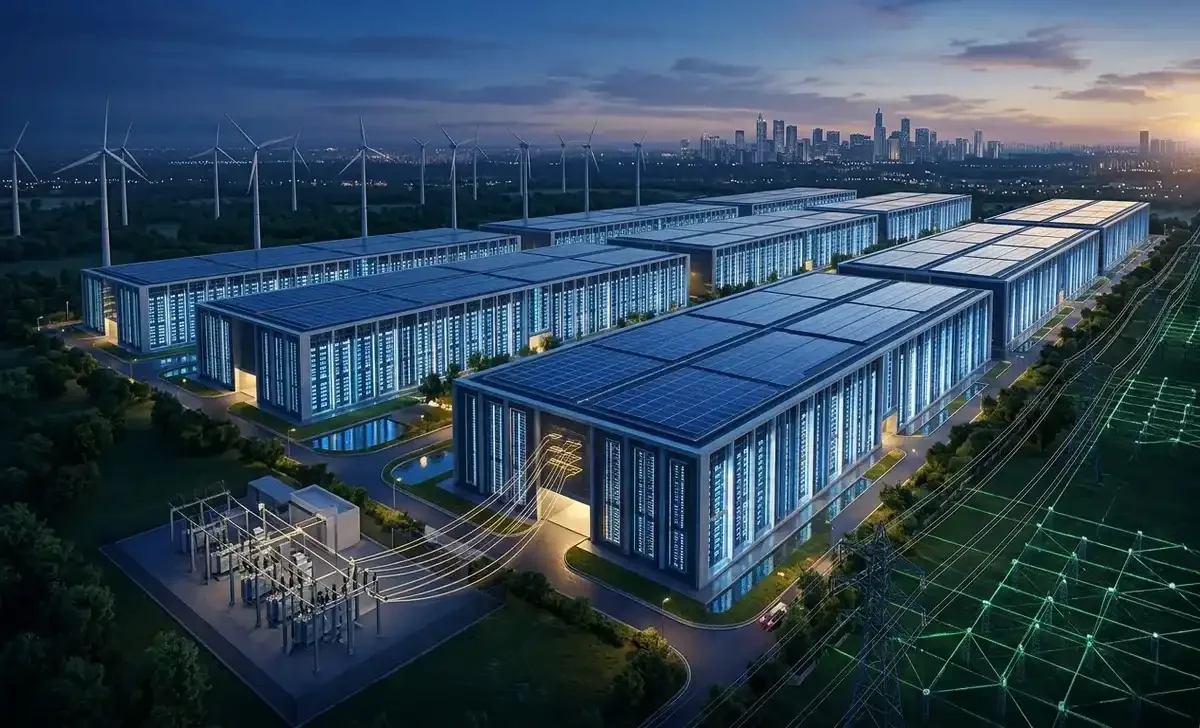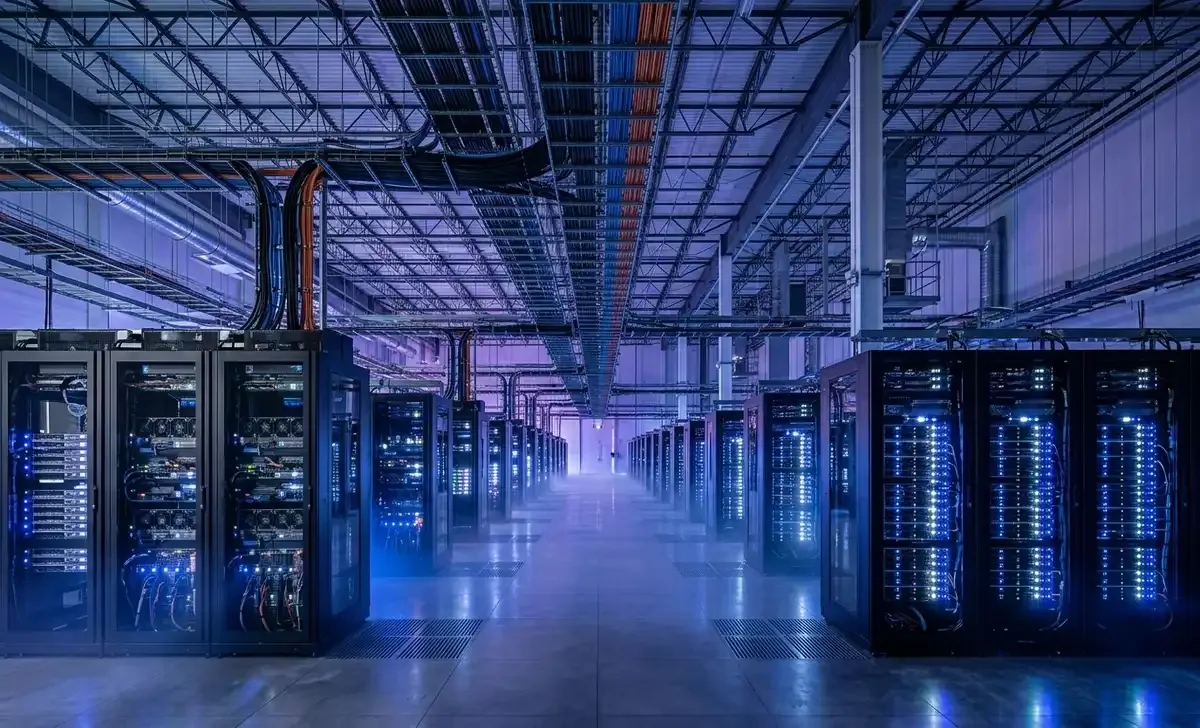
Every time you ask a chatbot a question, generate an image, or use an AI coding assistant, that request travels to a facility built specifically for one job: turning electricity and data into intelligence. These facilities are called AI factories, and they're being built faster and on a bigger scale than almost any infrastructure project in history.
NVIDIA CEO Jensen Huang didn't coin the term as marketing fluff. He was describing a real shift in how computing works. Traditional data centers store your files and run websites. AI factories do something closer to industrial production — raw data goes in, trained models and predictions come out, continuously, at a massive scale.
This guide goes past the buzzword. You'll learn exactly how AI factories are built, see real projects with actual power and cost figures, understand why they're straining electrical grids, and get a clear-eyed look at the risks that don't make it into the press releases.
What Is an AI Factory? (The Real Technical Definition)
An AI factory is a large-scale facility purpose-built to train and run AI models at an industrial scale. Unlike a general data center that hosts a mix of workloads — email, websites, file storage — an AI factory does almost nothing except two tasks: training new models and running inference (answering user requests) on models that already exist.
The "factory" analogy works because the process really does resemble manufacturing:
- Raw material: massive datasets (text, images, code, sensor data)
- Production line: thousands of GPUs working in parallel
- Output: a trained model, or millions of real-time responses per second
Jensen Huang has described this shift as fundamental: compute is becoming a product you manufacture, not just a resource you rent. That framing matters because it explains why Nvidia, Microsoft, and others are building facilities the size of small towns instead of just adding more server racks to existing buildings.
How AI Factories Actually Work: Training vs. Inference
Most explanations skip this, but it's the key to understanding why AI factories look the way they do.
Training is the process of teaching a model from scratch. It requires enormous, sustained compute power over weeks or months. A single large model training run can use tens of thousands of GPUs running continuously. This phase is extremely energy-intensive and happens in concentrated bursts.
Inference is what happens after training, every time someone actually uses the model. It's less intensive per request but happens constantly, at massive volume, across millions of users simultaneously.
Here's why this distinction matters: a facility optimized purely for training looks different from one optimized for inference. Training facilities prioritize raw compute density. Inference facilities prioritize low latency and geographic distribution, so responses come back fast, no matter where the user is located.
Most major AI companies now operate both types, often in separate locations.
Inside the Hardware: GPUs, Networking, and Cooling
The hardware inside an AI factory is unlike anything in a standard office data center.
GPUs. NVIDIA's Blackwell-generation chips currently power most large AI factories. A single Nvidia GB200 NVL72 rack links 72 GPUs together as one unit, delivering roughly 30x the inference performance of the previous generation for certain workloads. Facilities deploy hundreds or thousands of these racks.
Networking. GPUs need to talk to each other constantly during training. High-speed interconnects like NVLink and InfiniBand move data between chips fast enough that thousands of GPUs can effectively act as a single giant computer.
Cooling. This is the part most people underestimate. A rack of modern AI GPUs can generate as much heat per square foot as a jet engine test facility. Air conditioning alone can't handle it. Most new AI factories use direct liquid cooling, where coolant runs directly to the chip surface.
Power delivery. Facilities need dedicated substations and often on-site backup generation, because a sudden dip in power can crash a training run that's been running for weeks.
Practical example: Microsoft's Fairwater data center in Wisconsin was purpose-built around this exact hardware stack — liquid cooling, dense GPU clusters, and dedicated power infrastructure — rather than retrofitted from an older facility. That's a common pattern now: new AI factories are built from the ground up rather than converted.
Real-World Examples: The Biggest AI Factories Being Built Right Now
Numbers make this concept concrete. Here are actual projects, not hypotheticals:
| Project | Company | Scale/Detail |
|---|---|---|
| Stargate | OpenAI + Oracle + SoftBank | Planned $500 billion investment over four years across multiple US sites |
| Colossus | xAI | The Memphis, Tennessee, facility that scaled to roughly 200,000 GPUs within about a year of construction starting |
| Fairwater | Microsoft | Wisconsin facility built specifically for large-scale AI training, using liquid cooling throughout |
| Hyperion | Meta | Louisiana facility planned to eventually draw gigawatt-scale power, among the largest announced to date. |
These aren't small upgrades. Colossus, for instance, went from empty land to a functioning supercomputing facility in roughly 122 days — a construction timeline that's almost unheard of for traditional industrial infrastructure. That speed is only possible because these companies are pre-fabricating cooling and power modules off-site and assembling them like industrial equipment rather than building a conventional structure first.
The Cost Breakdown: What a Modern AI Factory Actually Costs
Building an AI factory involves several major cost categories, and hardware isn't even the largest one for the biggest projects.
Land and construction: Sites need to be large, structurally reinforced for heavy equipment, and located near existing high-voltage power lines. Rural sites with grid access are increasingly preferred over urban locations.
GPUs and chips: A single high-end AI GPU can cost tens of thousands of dollars. A large training cluster with 100,000+ GPUs represents billions in hardware alone before construction even starts.
Power infrastructure: Dedicated substations, backup generators, and, in some cases, direct deals with power plants can add hundreds of millions to a project.
Networking: The interconnects linking GPUs together are a significant line item, since they need to move data with almost no delay across the entire cluster.
For context, projects like Stargate are structured around commitments in the hundreds of billions of dollars over multiple years, spread across several physical sites rather than a single building. This is why only a handful of companies globally can build at this scale — the capital requirement alone excludes most players.
The Energy Problem: Why Power, Not Chips, Is the Real Bottleneck
Ask anyone actually building these facilities, and they'll tell you: the hardest part isn't getting GPUs anymore. It's getting electricity.
A large AI factory can require hundreds of megawatts, and the biggest planned facilities are targeting gigawatt-scale power draw — comparable to the output of a nuclear power plant. Utility companies in regions with major data center construction are already warning about grid strain.
This has led to some notable shifts:
- Companies are signing long-term power purchase agreements directly with energy producers
- Nuclear power, including restarting previously shuttered plants, has become a serious option for several major tech companies
- Some facilities are being built specifically near existing power infrastructure (hydroelectric dams, natural gas plants) rather than the other way around
Communities near these builds have started seeing real effects — some residential electricity rate increases have been linked to nearby data center demand in regional grid reports. This is quietly becoming one of the biggest political and regulatory issues tied to the AI boom, separate from the technology itself.
AI Factories vs. Traditional Data Centers: Key Differences
| Feature | Traditional Data Center | AI Factory |
|---|---|---|
| Primary workload | Websites, email, storage, mixed apps | AI model training and inference only |
| Cooling | Air conditioning | Direct liquid cooling |
| Power density | Moderate, spread across racks | Extremely high, concentrated per rack |
| Chip type | General-purpose CPUs | Specialized GPUs/AI accelerators |
| Build timeline | Often 18-24 months | Some were built in under 6 months using modular construction |
| Typical power draw | A few megawatts | Hundreds of megawatts to gigawatt-scale |
This table alone explains why old data centers usually can't simply be "upgraded" into AI factories — the power and cooling requirements are different by an order of magnitude.
Who's Winning the Global AI Infrastructure Race
The US currently leads on raw compute capacity, driven by Microsoft, Google, Amazon, Meta, OpenAI, and xAI. But this is a genuinely global race.
China has continued building domestic AI infrastructure despite chip export restrictions, leaning on both domestic chip development and creative workarounds to keep training large models. Chinese AI labs, including newer entrants that gained significant funding, have shown that infrastructure disadvantages can be partially offset with more efficient model architectures.
India is emerging as a major site for new data center investment, driven partly by cheap land and growing domestic demand for AI services.
The Gulf states (UAE, Saudi Arabia) have entered the race too, funding massive facilities partly to diversify their economies away from oil.
This competition isn't just commercial anymore — it's becoming a matter of national industrial policy, similar to how countries once competed over steel or semiconductor manufacturing capacity.
The Risks Nobody Talks About
Every AI factory announcement comes with impressive numbers. Here's what usually gets left out.
Overbuilding risk. Multiple analysts have flagged the possibility that companies are building compute capacity faster than actual paying demand can absorb, especially if AI adoption growth slows. If that happens, some of this infrastructure could sit underutilized, similar to the fiber-optic overbuild during the dot-com era.
Water usage. Liquid cooling doesn't eliminate water consumption — many facilities still use water-based cooling towers as a backup or supplement, and large sites can consume millions of gallons annually.
Grid strain and cost-shifting. As mentioned above, nearby communities sometimes absorb higher electricity costs to support facilities whose economic benefits (jobs, tax revenue) may not fully offset that burden.
Concentration of control. A small number of companies now control a disproportionate share of global AI compute. That raises real questions about who gets access to advanced AI capabilities and who gets priced out.
Limited permanent employment. These facilities create substantial construction jobs but relatively few permanent operational jobs once running, since the entire point is high automation.
A genuinely helpful article on this topic has to include these tradeoffs, not just the impressive statistics.
What This Means If You Run a Business
You almost certainly won't build an AI factory. Most businesses will access this computing power indirectly, through cloud AI services. Here's what to actually watch:
- Pricing will likely become more competitive as more compute capacity comes online, assuming demand doesn't outpace supply
- Latency will improve as inference-focused facilities get built closer to major population centers
- Vendor lock-in risk increases as fewer companies control the underlying infrastructure — diversifying which AI providers you rely on is a reasonable hedge
- Watch your AI vendor's infrastructure partners. If a provider depends heavily on a single cloud or chip supplier, supply disruptions can affect your service reliability
Practical example: A mid-sized SaaS company adding AI features should evaluate not just API pricing today, but whether their provider has secured long-term compute commitments. Providers without guaranteed capacity access may face price hikes or throttling during high-demand periods, something that's already happened with certain AI API providers during 2025 capacity crunches.
Expert Tips for Evaluating AI Infrastructure News
- Distinguish training capacity from inference capacity when a company announces new compute. They serve different purposes and aren't interchangeable.
- Check the funding structure, not just the headline number. Many multi-hundred-billion-dollar announcements are commitments spread across years and multiple partners, not a single upfront payment.
- Watch power purchase agreements, not just chip orders. Power availability is now the actual constraint on how fast new capacity can come online.
- Follow regional electricity rate filings in areas with major data center construction. This is often where real-world impact shows up first.
Common Mistakes People Make in Understanding AI Factories
- Treating chip announcements as the whole story. Power infrastructure is now the bigger bottleneck for most large projects.
- Assuming bigger always means better. Overbuilt capacity that outpaces actual demand is a real financial risk, not just a technical achievement.
- Ignoring the training vs. inference distinction. A facility built for one isn't automatically suited for the other.
- Underestimating the environmental footprint. Liquid cooling reduces some water use compared to older methods, but doesn't eliminate it.
- Assuming US dominance is permanent. China and other regions are closing the gap faster than many expected, particularly on model efficiency.
Conclusion
AI factories are the physical backbone behind every AI tool you use, from chatbots to image generators to coding assistants. They're not just bigger data centers — they're a fundamentally different kind of infrastructure, built around GPU density, liquid cooling, and power requirements that rival small cities.
Real projects like Stargate, Colossus, and Fairwater show this isn't speculative future technology. It's being built right now, at a pace and scale that's genuinely unprecedented. But the story isn't purely positive. Power strain, overbuilding risk, and infrastructure concentration are real tradeoffs that deserve as much attention as the impressive statistics.
If you're making business decisions around AI tools, understanding this infrastructure layer helps you ask better questions of your vendors and anticipate where pricing and reliability might shift next. Keep watching power purchase agreements and regional grid reports — that's where the next chapter of this story is actually being written.
Frequently Asked Questions
What exactly is an AI factory?
An AI factory is a facility purpose-built to train and run AI models at a large scale, using specialized GPUs, high-speed networking, and liquid cooling systems, rather than the general-purpose computing setup found in a typical data center.
How much power does an AI factory use?
Large AI factories typically use hundreds of megawatts, and the biggest planned facilities are targeting gigawatt-scale power draw, comparable to a mid-sized power plant's output.
How is an AI factory different from a regular data center?
Regular data centers run mixed workloads like websites and email using air cooling and moderate power density. AI factories run only AI training or inference workloads, using liquid cooling and far higher power density per rack.
How much does it cost to build an AI factory?
Costs vary by scale, but large projects like Stargate involve commitments in the hundreds of billions of dollars over multiple years, covering hardware, construction, power infrastructure, and networking.
Do AI factories create a lot of jobs?
They create substantial temporary construction employment but relatively few permanent operational jobs, since these facilities are designed to run with minimal ongoing staffing.