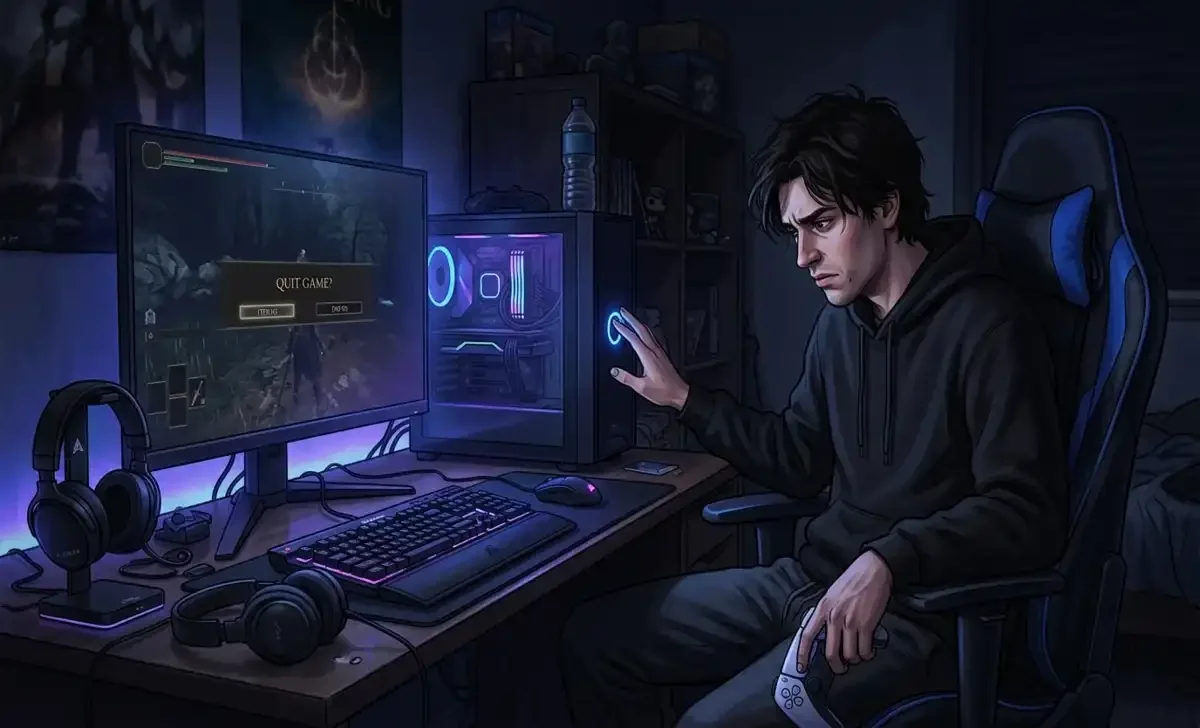
You load up a new game. Give it twenty minutes. Nothing hooks you. So you switch it off and move on to something else.
Sound familiar?
It happens to almost every gamer. And while there's nothing wrong with dropping a game that genuinely isn't for you, there's a real problem when it becomes a habit — jumping from title to title, never giving anything enough time to actually breathe.
If you've been wondering why gaming feels less satisfying lately, this might be exactly why.
In this article, we're breaking down the real reasons you should stop switching off games too early. We'll look at the psychology behind game-quitting, what you're actually losing when you bail, and practical strategies to stay engaged even when a game feels slow.
Whether you're a casual player or a hardcore enthusiast, there's something here for you.
You're Quitting Before the Game Actually Starts
Most modern games — especially RPGs, strategy titles, and open-world games — have a slow opening act. Developers use the first hour or two to introduce mechanics, characters, and world-building. This is intentional design, not bad pacing.
The problem is that many players quit right in the middle of this tutorial phase and assume the whole game is like that.
Think about games like Persona 5, Red Dead Redemption 2, or Final Fantasy XIV. Their openings are notoriously slow. But the players who pushed through ten hours? Many call them their favourite games of all time.
What to do instead: Give any new game at least three to five hours before making a decision. Set a personal rule and stick to it. You'll be surprised how often the game shifts gears completely.
You're Training Your Brain to Crave Instant Gratification
Every time you switch off a game the moment it bores you, you're reinforcing a mental pattern. You're training your brain to expect instant engagement — and when it doesn't come, your brain sends a signal to quit.
This is actually a well-documented behavioural loop. The more you reward short attention spans, the shorter they get. Over time, even genuinely great games can feel dull if your brain has been conditioned to expect a dopamine hit every two minutes.
This is especially relevant in a world where short-form content and algorithm-driven feeds are designed to hook you instantly. Gaming is different. The best experiences often require patience.
- Stick with one game for a week before jumping to the next
- Take breaks instead of quitting entirely
- Avoid browsing your game library while playing — it invites distraction
Staying consistent with games builds the same mental muscles you'd use for reading a novel or watching a slow-burning TV series.
You're Missing Real Skill Development
Gaming isn't just entertainment. Many titles — particularly fighting games, strategy games, and competitive shooters — have genuine skill ceilings that take weeks or months to reach.
When you quit early, you never get to experience the satisfaction of actually getting good at something. There's a reason the phrase "git gud" exists in gaming culture. It's not just trolling — it reflects a real truth: mastery takes time, and mastery is deeply satisfying.
Games like Elden Ring, StarCraft II, or Street Fighter 6 are genuinely hard at the start. They're designed to challenge you. Switching off games before you've climbed even partway up the learning curve means you'll never feel that "I finally did it" moment — which, for many players, is the most rewarding experience gaming offers.
The Story Hasn't Had Time to Hook You
Narrative-driven games are their own category when it comes to pacing. A book doesn't reveal its full plot in the first five pages. Neither does a well-written game.
Writers and game designers spend years building layered stories with twists, character development, and emotional payoffs. But those payoffs only hit if you've put in the time to care about the characters and world.
Switching off games early in a story-rich title is like abandoning a novel at chapter two. You've got none of the context that makes the later events meaningful.
Games like The Last of Us, Disco Elysium, and NieR: Automata are prime examples of titles that reward patience with some of the most emotionally powerful moments in all of entertainment — but only if you stick around long enough.
You're Chasing a Feeling That Doesn't Exist
There's a concept in psychology called the "greener grass" bias. We tend to imagine that the next thing will be more satisfying than the current thing — even when there's no evidence for it.
Applied to gaming, this means constantly switching off games because you assume the next one in your library will finally scratch that itch. But when you load up the new game, the same thing happens. It doesn't immediately feel perfect, so you move on again.
The uncomfortable truth? That perfect feeling you're chasing often comes from the game you're already playing — you just haven't reached it yet.
Sticking with one game teaches you to engage more deeply rather than skimming the surface.
Multiplayer Games Require Time Investment to Enjoy
If you play competitive online games and keep switching off after a few matches, you're genuinely handicapping yourself.
Multiplayer titles like Valorant, Apex Legends, or League of Legends have layered metagames, team dynamics, and mechanical skills that only emerge after extended play. In early sessions, you'll often feel lost, outpaced, and frustrated. That's normal. Every player goes through it.
The players who rise to higher skill brackets — and genuinely enjoy the game — are the ones who are committed to the learning process. They lost matches, analysed what went wrong, and kept going.
Consistently quitting multiplayer games early also means you rarely build rapport with regular teammates, which is where a lot of the fun actually lives.
You're Losing Money Without Realising It
Let's be blunt: games cost money. Full-price titles regularly run £50–£70. If you switch off games after an hour and move to the next purchase, you're burning through cash at a remarkable rate.
This is worth thinking about — especially with digital storefronts making impulse purchases frictionless. The "wishlist then buy on sale" approach is smart. But even discounted games represent wasted money if you never give them a proper chance.
If you're consistently switching off games and adding new ones to your library, it might be worth reading about how tech consumption trends are shifting — because the psychology of buying and abandoning digital products is part of a much bigger pattern in how we consume media and technology today.
A useful rule: finish (or genuinely exhaust) what you have before you buy something new.
Your Gaming Backlog Is Making Things Worse
A massive backlog creates a paradox of choice. When you have 200 unplayed games, committing to one feels almost impossible because you're always aware of the alternatives.
This is a real psychological burden. Researchers call it "decision fatigue" — the more choices you have, the harder each choice becomes, and the less satisfied you feel with any of them.
The fix isn't to buy fewer games (though that helps). It's to make deliberate choices about what you're playing and commit to that choice fully.
Try this:
- Pick one game per genre you're actively playing
- Remove unplayed games from your "in progress" list
- Don't browse your library during a mid-game session
Structure reduces chaos — and chaos is a big reason people keep switching off games without finishing them.
Some Games Are Slow Burns — and That's the Point
Not every game is designed to deliver immediate thrills. Some are built around atmosphere, exploration, and gradual discovery. These are often called "slow burn" games — and they're among the most critically acclaimed titles ever made.
Shadow of the Colossus, Journey, Subnautica, Kentucky Route Zero — these games require you to surrender to their pace. They won't hold your hand or deliver constant action. But the experiences they create are unlike anything a faster-paced game can offer.
Switching off games like these after thirty minutes is like walking out of an art exhibition because the first painting didn't excite you immediately.
If you know you're going into a slow-burning title, adjust your mindset before you start. Decide that you're giving yourself to the experience, not judging it as quickly as possible.
You're Missing the Community and Social Side
Many games have thriving communities built around them — forums, subreddits, Discord servers, YouTube channels, and content creators. But you only get access to this world in a meaningful way once you've invested real time in the game itself.
Spoiler-free guides, fan theories, community events, seasonal content — all of this is locked behind engagement. Players who stop switching off games and actually commit find that the social layer often becomes as enjoyable as the game itself.
This is particularly true for live-service games and MMOs, where the community creates events, inside jokes, and shared history that no developer could script.
It's also worth noting that as screens and tech evolve — from wearable fitness tech to screenless fitness bands designed to reduce distraction — our relationship with digital leisure is being reshaped. Gaming communities are one of the few places where deep, sustained digital engagement still produces genuine human connection.
Expert Tips
Here are some practical strategies that experienced gamers use to stay consistent and stop switching off games prematurely:
Set a time commitment rule. Before starting any new game, decide you'll give it a minimum of five hours. Write it down if you need to. This removes the temptation to quit at the first sign of slow pacing.
Play with intention. Before each session, ask yourself what you're trying to accomplish — progress a quest, improve a skill, explore a new area. Purposeful gaming feels more rewarding.
Take breaks, not exits. If you're frustrated or bored, close the game and walk away for an hour. Come back fresh. Most of the time, a short break resets your mood entirely.
Read nothing before you're ready. Avoid guides, walkthroughs, and reviews until you've formed your own initial impression. Spoilers and other players' opinions can poison your experience before you've given yourself a fair shot.
Keep a gaming journal. Note what you're playing, what you enjoyed, what frustrated you, and your progress. It creates accountability and makes switching off feel like a deliberate choice rather than a reflex.
Common Mistakes to Avoid
Judging a game by its opening hour. Almost every beloved game in history has a slow start. Give it time.
Playing when you're already tired or distracted. Gaming while exhausted leads to poor sessions that colour your opinion of the game unfairly. Play when you're actually present.
Comparing it to other games too early. "This isn't as good as X" is a dangerous frame when you've barely started. Let a game be itself.
Chasing trends instead of your own taste. Just because a game is popular doesn't mean it's right for you — and vice versa. Stop switching off games based on external validation.
Ignoring accessibility options. If difficulty is the barrier, most modern games have accessibility settings that can make the experience far more enjoyable without feeling like cheating.
As digital attention becomes more fractured — with concerns being raised even about how always-on digital tools might affect cognitive habits (something researchers and writers are increasingly exploring, including discussions around AI and mental focus) — gaming done right can actually be one of the healthier forms of sustained digital focus.
FAQs
How long should I give a game before quitting?
A good benchmark is five hours for story-driven games and around ten for RPGs or open-world titles. For multiplayer games, give yourself at least ten to fifteen hours to learn the basics before forming a real opinion.
Is it okay to stop playing a game if I genuinely don't enjoy it?
Absolutely. Not every game is for every person. The key is distinguishing between "this isn't for me" and "I haven't given it a fair chance." Quitting after five hours of genuine effort is fine. Quitting after twenty minutes isn't the same thing.
Why do I keep buying new games when I haven't finished my current ones?
This is extremely common and tied to the way digital storefronts are designed to encourage impulse purchases. Try a "one in, one out" rule — only buy a new game once you've properly finished or genuinely exhausted your current one.
How do I stay motivated when a game gets difficult?
Break progress into smaller goals. Instead of "finish the game," aim for "complete this chapter" or "beat this boss." Celebrate small wins. Join online communities where others are going through the same challenges.
Are there games that are genuinely not worth finishing?
Yes. If a game has fundamentally poor design, technical issues, or content that you find genuinely unpleasant rather than challenging, it's fine to stop. Not every game deserves your time. But be honest with yourself about why you're stopping.