Hyundai is best known for cars — but behind the scenes, it has assembled one of the most complete robotics portfolios of any company in the world. It owns Boston Dynamics, builds its own line of industrial robot arms, and is investing heavily in AI-driven automation for factories, warehouses, hospitals, and eventually homes.
This guide breaks down what Hyundai's robotics division actually consists of, how the pieces fit together, what each robot is realistically used for today, and what businesses should know before considering a deployment. If you've searched for "Hyundai robot," "Hyundai Boston Dynamics," or "Spot robot Hyundai," this is the deep dive that answers those questions.
Hyundai's Robotics Portfolio at a Glance
| Robot / Division | Type | Primary Use Case | Status |
|---|---|---|---|
| Boston Dynamics – Spot | Quadruped (legged) | Industrial inspection, hazardous environments | Commercially deployed |
| Boston Dynamics – Atlas | Humanoid | Manufacturing manipulation, R&D | In testing/pilot deployment |
| Boston Dynamics – Stretch | Mobile warehouse robot | Truck unloading, box handling | Commercially deployed |
| Hyundai Robotics (industrial arms) | Fixed articulated arms | Welding, painting, assembly, packaging | Mature, widely sold |
| Hyundai service robots | Mobile/autonomous units | Hospitality, healthcare, retail | Pilot/early commercial |
This table is the core of Hyundai's pitch: rather than betting on one robot type, the company is building a vertically integrated stack — hardware, AI software, and deployment experience — across nearly every robotics category with current commercial demand.
How Hyundai Became a Robotics Company
Hyundai Motor Group's robotics ambitions started on the factory floor. For decades, Hyundai Heavy Industries (later Hyundai Robotics) built welding, painting, and assembly-line robots used across the group's own automotive plants.
The trajectory changed when Hyundai stopped treating robotics as a manufacturing support function and began positioning it as a standalone growth business — one that could eventually rival automotive and hydrogen energy as a core pillar of the company. That shift required credibility in advanced mobile robotics and a foothold in AI software, both of which were achieved through one deal.
The Boston Dynamics Acquisition
In June 2021, Hyundai Motor Group acquired an 80% controlling stake in Boston Dynamics from SoftBank for approximately $1.1 billion — one of the largest robotics acquisitions in history.
Boston Dynamics had spent years building a reputation through viral demo videos of robots doing backflips and parkour, but previous owners (Google, then SoftBank) had struggled to turn that engineering prowess into a sustainable product line.
Under Hyundai's ownership, the focus shifted hard toward commercialization. Spot moved from research curiosity to a robot with real enterprise customers paying recurring software and hardware fees. Atlas shifted from acrobatic demos to a platform being evaluated for factory tasks. For Hyundai, the deal compressed roughly a decade of R&D into a single transaction; for the industry, it signaled that legged and humanoid robots were moving from "someday" to "now."
Spot: The Robot Doing the Jobs Humans Don't Want
Spot is the most commercially mature product in Hyundai's robotics lineup, and it's worth understanding why it succeeded where flashier robots haven't: it solves a narrow, expensive problem extremely well.
Spot is a four-legged robot capable of climbing stairs, traversing rubble, and operating on uneven terrain that wheeled robots can't handle. It can carry payloads up to roughly 14 kg and run pre-programmed inspection routes autonomously, repeating the same path with near-identical precision every time.
Practical example: A natural gas processing facility might deploy Spot to walk a fixed route through a high-temperature, high-noise area three times per day, checking pressure gauges, listening for abnormal valve sounds with onboard microphones, and flagging thermal anomalies with an infrared camera. Previously, this required a technician in protective gear making the same walk manually — now the technician reviews Spot's data remotely and only goes on-site when something is flagged.
Common deployment scenarios include oil, gas, and energy infrastructure (monitoring pipelines and pressure systems in explosion- or toxic-gas-risk environments), construction site documentation (consistent progress photos and 3D scans), nuclear and radiation-zone inspection (minimizing human exposure time), and security patrols (scheduled checks with thermal cameras).
Spot's modular sensor payloads — cameras, LiDAR, gas detectors, thermal imaging — mean the same hardware platform can be reconfigured for very different industries, which is a big part of why it's the first Boston Dynamics product to reach genuine commercial scale.
Atlas: From Acrobatics to Actual Work
Atlas is Boston Dynamics' humanoid platform, and it has gone through one of the more interesting pivots in robotics. The earlier hydraulic version became famous for backflips, parkour, and dance routines — impressive, but not factory-ready.
The newer electric Atlas is a deliberate departure: at roughly 1.5 meters tall and around 89 kg, it's built for manipulation — picking up parts, sorting components, and placing them into assembly sequences, tasks still too variable for traditional fixed robot arms.
Hyundai has been testing Atlas in its own manufacturing environments, treating its factories as a live testbed before any broader rollout — the same internal-first approach Hyundai used for its industrial arms decades earlier.
Humanoid robotics is one of the most heavily funded categories in robotics globally, and as AI demand trends continue to accelerate, platforms like Atlas are positioned to benefit from the broader wave of investment flowing into physical AI — robots that combine large-model reasoning with real-world manipulation.
Hyundai's Industrial Robot Arms: The Quiet Workhorses
Long before Boston Dynamics entered the picture, Hyundai Robotics was already a serious — if less visible — player in industrial robot arms.
The lineup spans payload capacities from compact 3 kg units for electronics assembly up to heavy-duty arms handling 300+ kg loads for automotive body panels. These robots handle automotive welding and painting, electronics assembly, food and beverage packaging, and palletizing and material handling.
What gives these robots credibility isn't marketing — it's that they run on Hyundai's own production lines, which demand extreme precision and near-zero downtime. A robot that survives multi-shift automotive production at Hyundai's scale has effectively been stress-tested in one of the harshest commercial environments available. Manufacturers comparing automation vendors increasingly mention Hyundai's industrial arms alongside established names like FANUC and Kuka, particularly on price-to-performance for mid-range payload classes.
The AI and Compute Layer Behind the Robots
Every robot in this lineup — from Spot's navigation to Atlas's manipulation — depends on software that's improving faster than the hardware itself.
Hyundai's robots combine computer vision, machine learning, and reinforcement learning to interpret their surroundings and adapt in real time. Spot doesn't just follow a pre-mapped route blindly — it uses onboard AI to replan its path when it hits an obstacle that wasn't there last time.
A critical, often-overlooked piece is hardware. Running these models on the robot itself, rather than relying on a constant cloud connection, is essential for reliability where connectivity is patchy. This is where purpose-built AI CPUs and accelerators come in — they let robots run inference locally, cutting latency and reducing the risk of a robot "freezing" mid-task.
Hyundai is also building fleet-level intelligence, aggregating data from every deployed robot to retrain and improve the underlying models. A Spot unit inspecting a refinery in one country can indirectly benefit from edge cases another Spot unit encountered on a construction site elsewhere — a feedback loop that compounds: more deployments lead to better models, better models lead to more reliable robots, and more reliable robots lead to more deployments.
Stretch: Solving Warehouse Automation's Hardest Job
While Spot gets the attention, Stretch is arguably Boston Dynamics' most commercially significant product right now — because it targets one of the most painful, injury-prone jobs in logistics: unloading trucks.
Stretch combines a mobile base with a single arm and a suction gripper, using computer vision to identify and pick boxes of varying sizes, weights, and orientations from a densely packed trailer. Unlike Spot, which mainly collects data, Stretch performs physical labor that directly replaces a repetitive task humans currently do, often at the cost of long-term back injuries.
Practical example: In a distribution center receiving dozens of trailers per shift, a Stretch unit positioned at a dock door can unload floor-loaded boxes onto a conveyor at a pace that matches or exceeds a human dock worker — without breaks, and without the injury risk that makes this role so hard to staff.
Major logistics operators have already begun piloting Stretch across distribution networks, and as e-commerce volume continues to outpace warehouse labor availability, this category is likely to shift from "pilot program" to "standard equipment" faster than most others on this list.
Service Robots: Hyundai's Bet on Public-Facing Automation
Industrial and warehouse robots operate largely out of sight. Hyundai's service robotics division is the opposite — designed to work around people, in spaces where appearance, predictability, and safety matter as much as raw capability.
Target environments include hospitals (delivering medications, lab samples, and meals between departments), hotels (room service and concierge assistance), restaurants (food running between the kitchen and tables), and retail (inventory scanning, restocking alerts, and wayfinding).
These robots typically rely on pre-mapped floor plans and LiDAR navigation to move autonomously through shared spaces. The real challenge is human-robot interaction — a robot that moves unpredictably or startles people will be rejected even if it's technically capable. Hyundai has invested in refining how its service robots signal intent: slowing near people, audible cues before turns, and predictable speeds.
This category matters most where demographics are shifting fastest. In rapidly aging societies like South Korea and Japan, service robots are increasingly seen as a partial answer to healthcare and hospitality labor shortages, not a novelty.
Smart Factories: Where Robots Become a Data Problem
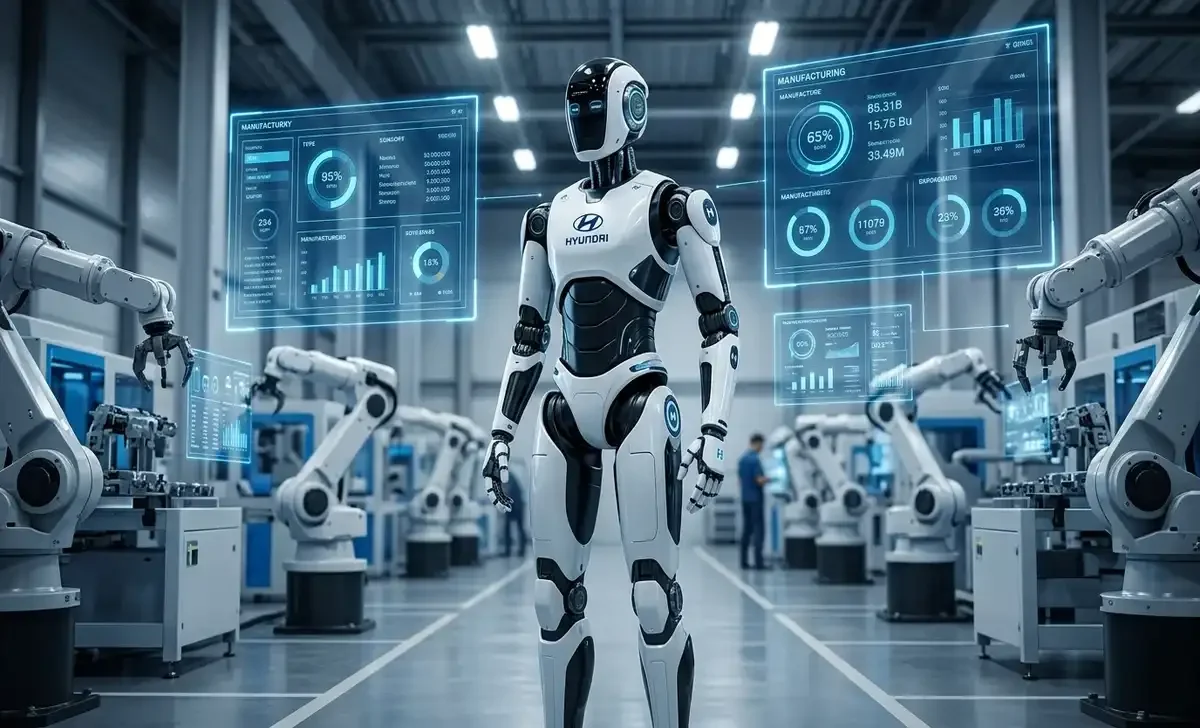
Hyundai's long-term vision isn't just "more robots" — it's an integrated "Intelligent Factory" model where robots, IoT sensors, digital twins, and AI analytics operate as one connected system.
Every robot on the line is also a sensor. Data on cycle times, error rates, and component quality feeds dashboards that flag maintenance needs before failures happen and adjust production parameters automatically. Hyundai has been piloting this in its own plants, reportedly with measurable reductions in unplanned downtime and defect rates — and only after proving the model internally does it extend to external customers.
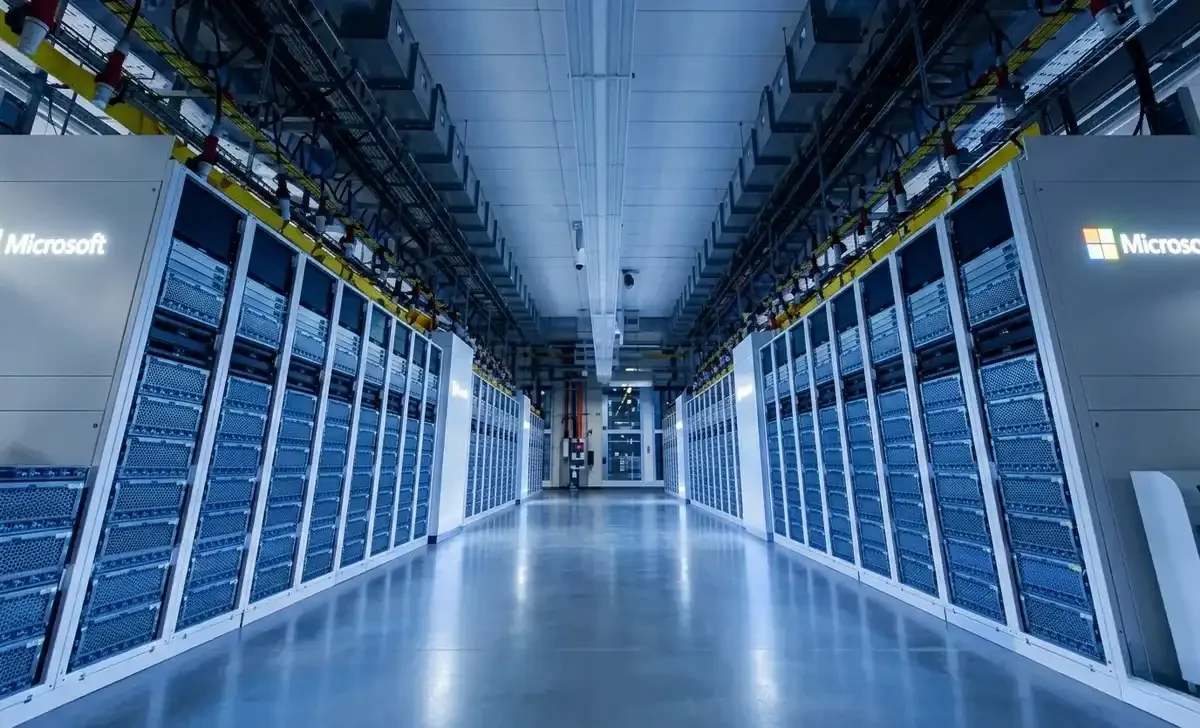
A single smart factory floor can generate more sensor data per day than many companies' IT infrastructure was built to handle a decade ago, which is why the rapid build-out of data center capacity across Asia matters for robotics. Without regional compute and storage close to where data is generated, "smart" manufacturing doesn't scale.
What's Next: Hyundai's Robotics Roadmap
Hyundai has been explicit that robotics is meant to become a core business line, not a side bet. Stated priorities include moving Atlas toward broader commercial deployment, expanding Spot and Stretch into new industries and geographies, developing AI for unstructured environments, opening robot platforms to third-party developers, and investing in exoskeleton technology for worker support and rehabilitation.
The competitive landscape is intense — Tesla's Optimus, Figure AI, Agility Robotics, and Chinese manufacturers are all chasing humanoid deployment at scale. Hyundai's advantage is less about any single robot being "better" and more about having an already-deployed fleet generating real operational data — and in robotics, that data is the moat.
How to Evaluate a Hyundai Robotics Deployment for Your Business
A few principles separate successful deployments from stalled ones:
Start from the task, not the robot. Identify a specific, measurable problem — "40 hours per week of manual pipeline inspection in a hazardous zone" — and work backward to whether a robot solves it.
Budget for integration, not just hardware. The purchase or lease price is often the smallest line item; connecting the robot to existing systems and training staff typically costs more.
Run a real pilot. A six-week pilot on your actual site — your lighting, layout, and noise levels — tells you more than any case study from elsewhere.
Plan for the data. A single Spot unit can generate gigabytes of sensor data per week; without a plan to review and act on it, the robot becomes an expensive camera nobody watches.
Bring frontline staff in early. Workers who feel a robot is imposed on them tend to under-report issues or work around it; early involvement leads to smoother rollouts.
Conclusion
Hyundai's robotics strategy is unusual in how broad it is. Most companies in this space pick a lane — humanoids, warehouse automation, or industrial arms — and specialize. Hyundai is doing all three at once, backed by a manufacturing base large enough to test everything internally before it reaches a customer.
For businesses evaluating automation, the practical question isn't "should we buy a Hyundai robot" — it's "which expensive, repetitive, or hazardous task in our operation maps most closely to what Spot, Stretch, or Hyundai's industrial arms already do well." The companies getting real value start with a narrow problem, pilot rigorously, and build a data and staffing plan around the robot from day one — not chase the most impressive demo video.
As AI computing, fleet data, and humanoid platforms like Atlas mature, the gap between "robot demo" and "robot doing your job reliably" is closing fast — and Hyundai is positioned to be one of the companies that closes it.
FAQs
What robots does Hyundai actually make or own?
Hyundai Robotics makes industrial robot arms for welding, painting, assembly, and packaging. Through its 2021 Boston Dynamics acquisition, Hyundai also owns Spot (quadruped inspection robot), Atlas (humanoid in testing), and Stretch (warehouse unloading robot), plus service robots for hospitals, hotels, and retail.
Is Boston Dynamics owned by Hyundai?
Yes. Hyundai Motor Group acquired an 80% controlling stake from SoftBank in June 2021, in a deal valued at approximately $1.1 billion.
How much does a Boston Dynamics Spot robot cost?
Spot's base hardware has historically been priced around $74,500, with extra costs for sensor payloads, software subscriptions, and support. Enterprise leasing is also available.
Can Atlas be bought commercially right now?
Not yet. Atlas is being tested within Hyundai's own manufacturing environments, with commercialization expected once the platform proves reliable at scale.
How is Stretch different from Spot?
Spot is a mobile sensor platform that inspects and reports. Stretch is a manipulation robot that physically moves boxes in warehouses. Different problems, different settings.
Are Hyundai's robots safe to work around?
Both companies design mobile robots with predictable movement, obstacle detection, and human-aware navigation. Any deployment near workers should still go through a formal safety risk assessment.
Will Hyundai's robots replace factory jobs?
So far, robots have mostly taken over specific high-risk or repetitive tasks rather than eliminating roles. The more consistent pattern is workers shifting from doing the task to supervising or maintaining the robot that performs it.