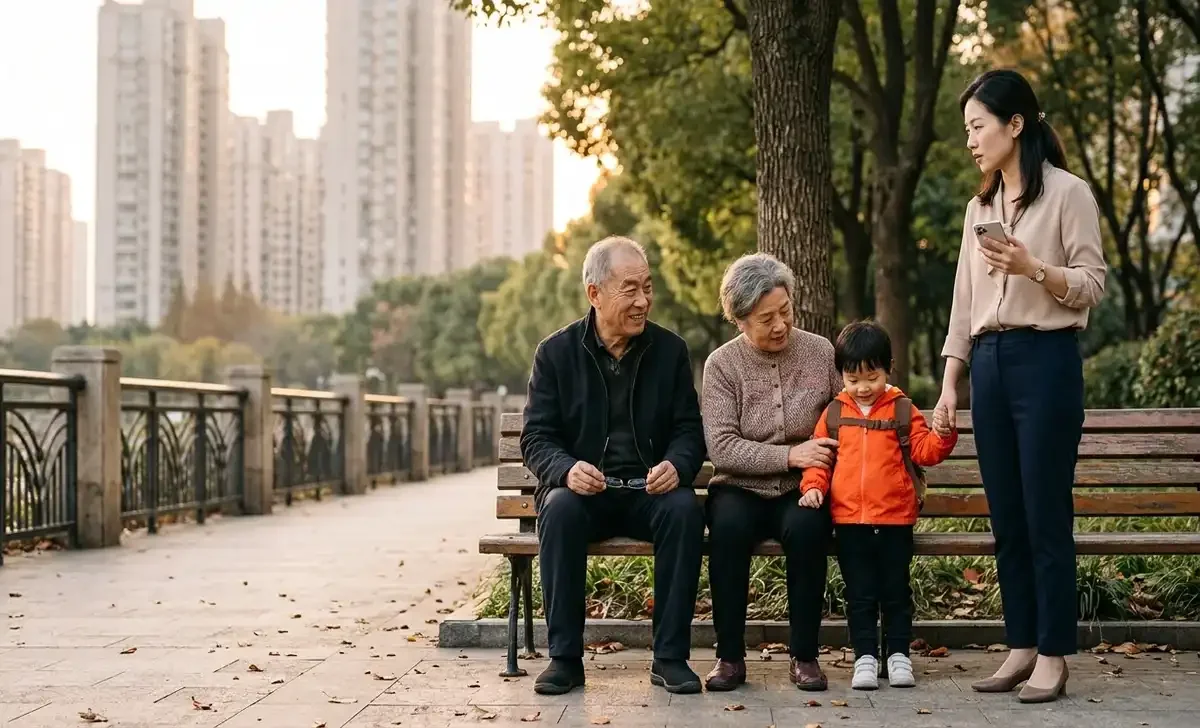
China now supports more older people than children. Newly reported figures from the National Bureau of Statistics show that the old-age dependency ratio reached 23.1% in 2025. The child ratio was 22%. It is the first time the elderly number has been higher.
That is a big change for a country that spent decades worrying about too many people. China’s elderly population is growing, births are at record lows, and the number of working-age adults is shrinking. Together, these trends are reshaping family life, pensions, healthcare, and economic growth.
This guide explains what the numbers mean, why the shift happened, and what comes next.
China’s Aging Population Reaches a Significant Milestone
The Latest Figures on China’s Elderly and Child Populations
The numbers come from the China Statistical Yearbook 2026, reported by Chinese media and international outlets including Reuters. They show a clear gap:
- People aged 65 and over: about 223.65 million, or 15.9% of the population
- Children aged 0 to 14: about 212.76 million, or 15.1% of the population
The country’s total population fell to about 1.405 billion in 2025. That was the fourth straight year of decline. Births dropped to 7.92 million, down 17% from 9.54 million a year earlier, while deaths rose to 11.31 million.
Broader measures tell the same story. About 323 million people were aged 60 or older in 2025. That is 23% of the population, up one percentage point from 2024.
Understanding China’s Old-Age Dependency Ratio
The old-age dependency ratio sounds technical, but the idea is simple. It compares the number of older people to the number of people of working age (15 to 64). A ratio of 23.1% means there are 23.1 people aged 65 or older for every 100 working-age adults.
The child dependency ratio works the same way for people aged 14 and under. In 2025, that figure was 22. Add the two together, and you get the total dependency ratio, which stood at 45.1%.
Two details are worth noting. First, this is a statistical measure. It does not mean each worker personally pays for one older person. Second, the trend matters more than a single year. The elderly ratio rose from 15% in 2016 to 20.8% in 2021 and 22.8% in 2024. In 2024, the child ratio was still slightly ahead at 23%. The lines crossed in 2025 and are unlikely to cross back soon.
Why Is China’s Population Aging?
No single cause explains it. Several forces have pushed in the same direction at once.
Declining Birth Rates and Lower Fertility
China’s declining birth rate is the main driver. The fertility rate, meaning the average number of babies per woman, fell to about 0.97 in 2025, down from 1.02 in 2024, according to figures reported by AFP. A rate of roughly 2.1 is needed to keep a population stable without immigration.
When fewer babies are born each year, the share of older people rises, even if nobody is living longer. The 2024 uptick in births did not last. Births in 2025 fell by 1.62 million.
Longer Life Expectancy and Improved Healthcare
Chinese people are living longer, which is good news that comes with a bill. For more than four decades, the retirement age stayed at 60 for men and 55 for women in white-collar jobs, even as people lived well beyond those ages. That meant a longer stretch of retirement, and a longer period when pensions and health services were needed.
A growing share of the elderly population is also reaching very old age, when care needs tend to be highest.
The Long-Term Effects of the One-Child Policy
China limited most families to one child from 1980 to 2015. Rapid urbanization pushed birth rates down at the same time. The policy ended nearly a decade ago, but its effects are still unfolding.
The generation born under the policy is now raising its own children, and it is a smaller generation than the one before it. Fewer young women means fewer births, even if each woman wants more children than her parents had. Demographers sometimes call this “population momentum,” and it is hard to reverse quickly.
Rising Living Costs and Changing Family Preferences
Ending the policy did not bring a baby boom. Many young adults point to the cost of housing, education, and childcare, along with job uncertainty. Marriage rates have also been falling, and the number of women of childbearing age keeps shrinking.
Personal choices are part of this picture too. Many people simply want smaller families, or none at all. Money alone rarely changes that decision.
How China’s Aging Population Is Affecting Families
Statistics can feel distant. Inside a home, the shift looks like crowded schedules, tough money choices, and a lot of worry.
Growing Responsibilities for Working-Age Adults
For decades, a typical Chinese adult had many siblings, cousins, or neighbors to share family duties. Many of today’s working adults grew up as only children. They may be the sole caregiver for two parents, and sometimes four grandparents.
That is often described as a “4-2-1” family: four grandparents, two parents, and one child. It is a simplified picture, but it captures a real pressure. A single working adult can end up as the main source of emotional and practical support for several older relatives.
Balancing Elderly Care With Raising Children
Many families now sit in the middle of two kinds of care. They help children with school and daily life while also taking older parents to appointments and keeping an eye on their health.
The shift is visible in daily life. Some kindergartens, facing falling enrollment, have started offering combined child and elderly care, and many have been converted into nursing homes. When schools turn into care homes, it says a lot about where demand is heading.
The Financial Pressure of Supporting Older Relatives
Pension coverage and payouts vary widely across China, and rural retirees often depend more on their children than urban ones do. Medical bills, daily care, and lost working hours all add up.
When families spend more on older relatives, they have less to spend on children, housing, or savings. That tension helps explain why many people say they feel unable to afford a larger family. The two problems feed each other.
The Economic Impact of China’s Aging Population
A Shrinking Workforce and Labor Shortages
Fewer workers can mean higher labor costs and hiring gaps. By one measure from the National Bureau of Statistics, people aged 16 to 59 made up about 60.6% of the population in 2025, down from more than 70% a decade earlier.
This is not only a Chinese issue. Many industries around the world struggle to fill jobs, as shown in this look at how waste firms struggle to find staff. China’s challenge is its scale and speed.
Growing Pressure on Pensions and Healthcare
Pensions are funded largely by people who are working today. When the number of workers falls, and retirees rise, the math gets harder. Analysts have warned about the strain on China’s pension system for years.
Healthcare faces a similar squeeze. Older people use medical services more often, and long-term care takes both money and trained staff. Many of the policy changes below are aimed at easing exactly these pressures.
What an Aging Population Means for Economic Growth
Growth depends on how many people work and how productive they are. A smaller workforce makes it harder to grow at past speeds, unless workers become more productive through technology, training, and better use of resources.
China’s economy also faces other challenges at the same time, such as overcapacity in some industries, including batteries. That makes the demographic shift harder to absorb.
Older households also tend to save and spend differently from younger ones. Over time, that changes which businesses grow and which shrink.
How China Is Responding to Its Aging Population
Government Support for Older Adults
The most direct step so far is a higher retirement age. Men are moving from 60 to 63. Women in white-collar jobs are moving from 55 to 58, and women in blue-collar jobs from 50 to 55. Authorities have also said they will “prudently” keep working on gradual retirement reform.
The government is also reshaping social security and has promised more support for older adults, especially those with disabilities and those living in rural areas.
Policies to Encourage Births and Support Families
Beijing has moved from limiting births to encouraging them. Since 2025, families receive 3,600 yuan (about $500) per year for each child under three. Authorities have also waived fees for public kindergartens and pledged to make preschool education progressively free. Other steps include lowering childbirth-related medical costs.
The results so far are modest. Births fell sharply in 2025, and some analysts say the cash is small compared with the real cost of raising a child. One Caixin commentary estimated the subsidy covers only about 2% of those costs. Experts say money helps, but it works best alongside affordable housing, flexible work, and job security for parents.
Expanding Elderly Care and Community Health Services
China’s official work report promises more “public interest” elderly care services, especially in rural areas. Plans also call for stronger community health services, so older people can get help closer to home instead of relying on hospitals or on relatives.
Elderly care in China has long relied on the family. The new direction is a mix of family, community, and paid services.
The Silver Economy: Opportunities in an Aging Society
Aging is a challenge, but it also creates demand. Officials have said they want to promote “high-quality development of the silver economy,” aimed at people aged 60 and older.
Growing Demand for Healthcare and Elderly Care
More older people means more need for nurses, caregivers, home-care services, rehabilitation, and age-friendly housing. These are labor-heavy jobs, so they could also become a source of employment.
Technology may help too, from health monitoring to services that let older adults live at home longer. These tools could ease pressure on family caregivers, though they cannot replace human care.
The Changing Needs and Purchasing Power of Older Consumers
Today’s older consumers are often healthier, better educated, and more digitally connected than earlier generations. One Chinese platform report found that hobby-related spending has become a leading category for older people. It described a “belonging economy,” where seniors pay for community, purpose, and feeling needed.
That points to a market far wider than medicine: travel, learning, social clubs, and leisure. Companies that treat older adults as active customers, not just patients, may find the biggest opportunities.
What Does the Future Hold for China’s Aging Population?
Long-Term Challenges for Families and the Workforce
The path ahead is steep. Projections vary by source, but one widely used estimate puts the share of people aged 65 and over near 31% by 2050, and the total population at about 1.26 billion. Another analysis estimates about 39 older people for every 100 working-age Chinese by 2050.
That means more families will need to plan for long-term care, and more workers will need to stay employed longer. China is not alone. The United States and other large economies also face aging, and some are betting on technology to offset it, as explored in this piece on the US economy, aging, and AI.
The Importance of Sustainable Pensions and Age-Friendly Care
The biggest test is whether pensions and care systems can grow as fast as the elderly population. A system that works for 220 million people over 65 may not work for far more.
That will likely require steady pension funding, better rural coverage, trained care workers, and communities designed for older residents, with safe sidewalks, accessible clinics, and affordable services.
Conclusion
China’s aging population has crossed a line. For the first time, the country supports more older people than children. Behind the ratio are real families: working adults caring for parents, saving for children, and doing the math on what they can afford.
The response needs several parts working together: pensions people can count on, healthcare close to home, support for parents, and room for older adults to stay active and useful. The shift will not reverse quickly. How well China adapts will shape its society and economy for decades.
Frequently Asked Questions
Why is China’s population aging so quickly?
Births have fallen sharply while people live longer. The one-child policy (1980 to 2015), fast urbanization, high living costs, and later marriage all lowered the birth rate. Rising life expectancy then increased the number of older adults at the same time.
Are there more elderly people than children in China?
Yes, according to the latest figures. China had about 223.65 million people aged 65 and over in 2025, compared with about 212.76 million aged 0 to 14. The old-age dependency ratio (23.1%) also passed the child ratio (22%) for the first time.
How does China’s aging population affect its economy?
It shrinks the workforce, raises pressure on pensions and healthcare, and can slow growth. It also creates new markets, such as elderly care, health services, and products for older consumers.
What is China doing to support its elderly population?
China is raising the retirement age, expanding elderly care in communities and rural areas, and reforming social security. It is also supporting families with childcare subsidies, which aim to slow the decline in births over time.
How will China’s aging population change by 2050?
Projections differ, but most show the share of people aged 65 and over rising to roughly 30% or more, with a median age above 50 in some estimates. Actual outcomes depend on birth rates, health, and policy choices.