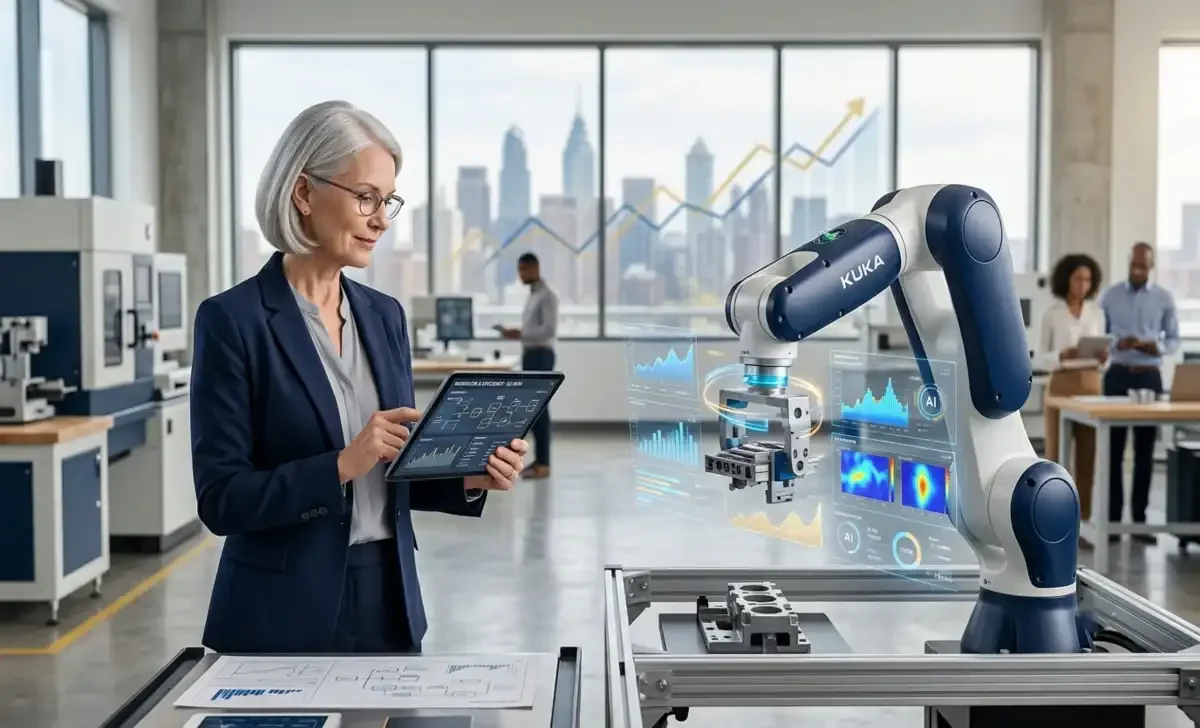
Two long-term trends are converging on the American economy at the same time, and most coverage still treats them as separate stories. One is demographic: a wave of experienced workers is leaving the labor force faster than younger workers are entering it. The other is technological: artificial intelligence is spreading through offices, hospitals, warehouses, and factory floors faster than almost any tool in recent memory.
Treated separately, each trend sounds familiar. Treated together, they explain something more specific — why certain industries are automating out of necessity rather than ambition, why wages are climbing in trades nobody expected, and why the usual "AI will take your job" narrative misses what's actually happening on the ground.
This piece looks at how workforce aging and AI adoption are interacting in practice, which industries are affected most, where the risks genuinely lie, and what workers and business owners can do about it now rather than after the disruption arrives.
Why the Workforce Is Aging Faster Than It Can Be Replaced
The core issue is straightforward: a large cohort of workers is retiring, and the generations behind them are smaller. Birth rates have declined steadily for years, which means the pipeline of new entrants into the labor force is thinner than the pipeline of people leaving it.
This isn't only about headcount. Workers nearing retirement often shift into part-time roles, step away from physically demanding work, or reduce their hours well before they officially retire. The labor force doesn't just shrink — it changes shape, often years before the official retirement statistics reflect it.
Economists sometimes describe the resulting slowdown as "demographic drag." Fewer available workers means fewer hands to produce goods and deliver services, even when consumer demand hasn't slowed at all. That mismatch — steady or rising demand against a shrinking labor supply — is the pressure point where AI adoption accelerates.
Immigration, Fertility, and the Missing Pressure Valve
For much of recent history, immigration acted as a release valve for labor shortages, particularly in construction, agriculture, food service, and caregiving. When immigration policy tightens, that valve narrows, and the gap it used to fill doesn't disappear — it just becomes harder to close.
Faced with that gap, employers generally have two real options: raise wages aggressively to compete for a shrinking pool of available workers, or invest in automation and AI tools to do more with the people they already have. Increasingly, businesses are choosing the second path — not because it's the cheaper option, but because in some regions and industries, there simply aren't enough workers to hire at any wage.
This dynamic has a parallel in global manufacturing. When China's battery overcapacity disrupted pricing and supply assumptions elsewhere, manufacturers didn't wait for the market to self-correct — they restructured sourcing and production strategies immediately. Labor shortages are prompting a similar kind of forced adaptation, just on the input of people rather than materials.
AI as a Labor Gap Filler, Not Just a Labor Replacer
The dominant cultural narrative about AI and jobs is displacement: machines taking roles people want. The reality in aging, understaffed industries looks different. In many cases, AI is stepping into roles that were already vacant.
Trucking and logistics companies are adopting route optimization software largely because they cannot recruit enough qualified drivers. Call centers are deploying AI-driven support because staffing round-the-clock human coverage in a tight labor market is genuinely difficult. Warehouses are turning to inventory and fulfillment AI because turnover in those roles has become chronic.
This distinction matters. It reframes AI adoption in aging industries less as a threat to employment and more as a response to a labor supply problem that already existed. That doesn't make the transition painless — workers who remain often need to learn new skills to operate alongside these systems, and not everyone adapts at the same speed — but it changes the conversation from "robots versus workers" to "robots versus empty desks."
Example: A regional distribution company that struggled for years to keep warehouse positions filled introduced automated sorting and route-planning software not to cut its existing staff, but because it could not otherwise fulfill the order volume it was already receiving. The remaining staff shifted toward oversight, exception-handling, and quality control — roles that require judgment the software doesn't have.
Healthcare: Where Both Trends Collide Hardest
Healthcare sits directly at the intersection of these two forces. An aging population needs more medical care, home support, and long-term services, right as the healthcare workforce itself is aging out and struggling to recruit replacements in nursing and home health roles.
AI is expanding into this gap through diagnostic support tools, scheduling and triage systems, and even robotic assistance in surgical settings. Pharmaceutical development is affected too — companies under pressure to bring treatments to market faster for a population with growing chronic care needs are increasingly turning to AI-assisted research, and drug firms are using AI to save time and money on processes that traditionally took far longer.
The upside is real: AI can extend the reach of an overstretched healthcare workforce, allowing fewer clinicians to safely manage more patients. The downside is just as real — over-reliance on AI diagnostics without adequate human oversight raises genuine safety questions that regulators are still working through, and the pace of adoption in healthcare has outstripped the pace of regulatory clarity in several areas.
Manufacturing and the Shift Toward Automated Quality Control
Manufacturing has faced worker shortages for a long stretch already. Younger workers frequently avoid factory-floor careers, and the workers who understand specific machinery best are often the ones nearing retirement, taking irreplaceable operational knowledge with them.
Robotics and AI-driven quality inspection are increasingly standard rather than experimental. Predictive maintenance software flags equipment issues before they cause downtime, and computer vision systems now handle inspection tasks that used to require multiple people per shift.
This shift connects to broader trade dynamics as well. Understanding the US trade gap helps explain part of why domestic automation investment has accelerated — manufacturers are trying to remain competitive without depending entirely on overseas labor or production capacity they don't control.
Is AI Actually Boosting Productivity Enough to Offset the Shortfall?
This is the question economists argue about most, and the honest answer is that results are mixed and still emerging. Some sectors — logistics and customer service among them — show clear, measurable productivity gains from AI adoption. Others, particularly where AI tools have been layered onto old workflows without any real process redesign, show little improvement at all.
The distinction usually comes down to implementation, not the technology itself. Companies that use AI adoption as an opportunity to rethink how work actually gets done tend to see meaningful gains. Companies that simply bolt a chatbot or dashboard onto an unchanged process tend to see very little change — sometimes even a temporary dip in output while staff adjusts.
Wage Pressure in Hard-to-Automate Industries
When qualified workers are scarce, wages rise — and that dynamic is playing out clearly across skilled trades, healthcare support, and specialized manufacturing roles. Electricians, plumbers, and HVAC technicians are seeing strong, sustained wage growth as demand keeps climbing while relatively few younger workers enter these fields.
Demand for HVAC expertise in particular is tied to broader climate and energy pressures. The way Singapore's air conditioning energy crisis highlighted rising global demand for cooling systems and the specialists who install and maintain them mirrors what's happening domestically — a physical, hands-on skill set that automation still can't meaningfully replicate.
For workers in trades that resist automation, this is genuinely good news. Wage growth in these fields has consistently outpaced general wage growth elsewhere in the economy in recent years.
Small Businesses Are Absorbing the Shock First
Large corporations generally have the capital to invest in custom AI systems and the scale to absorb labor shortages by spreading them across many locations. Small businesses rarely have that same cushion.
An independent auto shop, a local bakery, or a small logistics operator can't easily build or customize AI tools. Many rely on off-the-shelf software that helps around the edges but doesn't solve deep staffing gaps the way enterprise-grade systems can for larger competitors.
This is widening the gap between businesses that can automate at scale and small operators stuck absorbing labor costs directly. Essential local service industries — waste management and commercial cleaning among them — continue to report that firms are struggling to find staff, even as larger competitors in the same sector lean increasingly on automation to stay staffed.
Practical advice for small business owners: rather than attempting a full automation overhaul, look for affordable, task-specific tools — scheduling software, basic customer service bots, or bookkeeping automation. Small, targeted wins compound faster than an ambitious plan that never gets fully implemented.
The Quiet Cost of Retirement: Institutional Knowledge Loss
There's a cost to workforce aging that rarely shows up in economic reporting: the unwritten, undocumented knowledge that leaves with every retiring employee. How a specific machine actually behaves under stress, which client relationships need particular care, which shortcuts are safe, and which aren't — none of that is captured in a job description.
Some companies are now using AI-assisted documentation tools, structured training simulations, and internal knowledge bases built from interviews with retiring staff to capture this expertise before it disappears. Businesses that treat knowledge transfer as a deliberate, ongoing project — rather than something that happens naturally during a handover period — consistently manage retirements more smoothly than those caught off guard by a sudden departure.
What This Means If You're Early or Mid-Career
For workers earlier in their careers, this shift is not purely a threat — it also creates real opportunity. A shrinking overall labor pool means less competition for open roles in many fields, and skills that pair human judgment with comfort operating AI tools are becoming genuinely valuable across healthcare, skilled trades, and logistics.
The traditional model of a long, stable career with a single employer is also shifting, which matters if you're trying to figure out what the American Dream realistically looks like for your generation compared to the one before it.
The most durable advice here is simple: build skills that complement AI rather than compete directly with it — data interpretation, client communication, hands-on technical trades, and adaptable problem-solving all fall into that category.
Common Mistakes Businesses and Workers Make
- Treating AI adoption and workforce aging as unrelated stories. They're deeply connected, and planning for one without the other leads to poor decisions.
- Automating too aggressively, too fast. Companies that rush adoption without adequately training remaining staff often see quality drop before it improves.
- Ignoring knowledge transfer entirely. Losing experienced staff without documenting their expertise is an expensive, avoidable mistake.
- Assuming every job faces equal risk. Physical, hands-on trade work remains far more insulated from automation than routine office and administrative tasks.
- Underpricing labor in shortage-hit industries. Businesses that don't adjust compensation in genuinely tight labor markets tend to lose staff to competitors who do.
Conclusion
The American economy is navigating a combination it hasn't faced quite this way before: a workforce aging out faster than it can be replaced, arriving at precisely the moment AI tools are capable enough to meaningfully help fill the gap. This isn't simply a story about automation replacing people who want to work. It's a more complicated and, in many ways, more hopeful story — AI stepping into roles that worker shortages had already left empty, while simultaneously forcing overdue conversations about wages, training, and what work will look like in the years ahead.
The businesses and workers who treat this shift as something worth actively planning for — rather than something to react to after the fact — will consistently come out ahead. Whether that means learning a trade insulated from automation, auditing how your organization actually uses AI versus how it claims to, or simply paying closer attention to labor trends in your own industry, the moment to start is now, not once the shortage becomes a crisis.
Frequently Asked Questions
How is an aging population affecting the US economy?
An aging population shrinks the available labor force, tends to slow overall economic growth, and increases demand for healthcare and long-term care services, all while fewer new workers enter the labor force to replace those retiring.
Is AI replacing jobs because of the aging workforce, or because of the technology itself?
In many documented cases, AI is filling roles that were already going unfilled due to worker shortages rather than displacing workers who actively want those jobs. This varies significantly by industry and region, and it's rarely a clean either/or situation.
Which industries are experiencing the most visible effects?
Healthcare, manufacturing, logistics, and skilled trades show the clearest combined effects, since each faces meaningful worker shortages alongside rapid AI tool adoption.
Can AI fully solve labor shortages caused by an aging workforce?
Not entirely. AI can meaningfully offset shortages in certain sectors, but productivity gains vary widely by industry and by how well a company implements the technology. Hands-on physical work in particular remains difficult to automate.
What should workers do to prepare for these shifts?
Focus on skills that complement AI rather than compete with it, seriously consider skilled trades if hands-on work suits you, and stay adaptable as industries continue to evolve around both demographic and technological pressure at once.
Are small businesses affected differently than large corporations?
Yes. Large companies generally have the capital and scale to invest in custom AI systems and absorb shortages across multiple locations. Small businesses typically rely on off-the-shelf tools and feel labor shortages more directly and immediately.