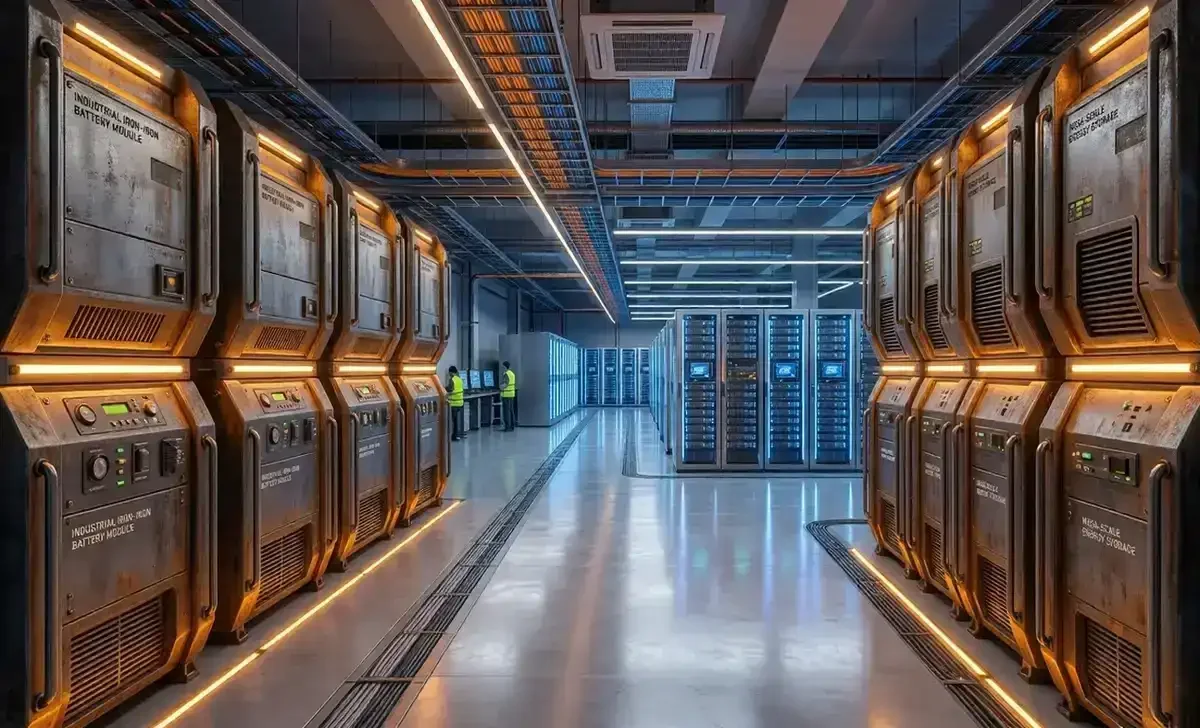
The energy crisis in data centers is real. And it's getting worse.
Data centers consume roughly 1–2% of global electricity — and that number is climbing fast with AI, cloud computing, and streaming. Traditional lithium-ion batteries have served us well, but they come with serious limitations: high cost, fire risk, and supply chain headaches.
Enter data center iron batteries — a technology that's quietly reshaping how the world's most power-hungry facilities store energy.
In this article, you'll learn exactly what iron batteries are, why major tech companies are paying attention, and 10 solid reasons why this "old" metal is powering the future of data centers.
What Are Iron Batteries?
Before diving into the benefits, let's get clear on the technology itself.
Iron batteries — most commonly iron-air batteries or iron flow batteries — use iron as the primary active material in the electrochemical reaction. The most talked-about version is the iron-air battery, which works by "rusting" iron when discharging (releasing energy) and "un-rusting" it when charging.
Yes, essentially controlled rusting. It sounds almost too simple, but the electrochemistry behind it is sophisticated and proven. In many ways, iron batteries are a masterclass in innovation without technology complexity — drawing transformative value from one of Earth's oldest, most familiar materials rather than chasing expensive new ones.
Companies like Form Energy (backed by Bill Gates' Breakthrough Energy Ventures) and ESS Tech are leading the commercialization of iron-based storage systems. These aren't lab experiments anymore — they're being deployed at utility and data center scale right now.
Why Data Centers Need Better Batteries
Data centers can't afford power outages. Even a few milliseconds of downtime can cost millions and damage reputation. Traditional UPS (Uninterruptible Power Supply) systems rely heavily on lead-acid or lithium-ion batteries.
Here's the problem:
- Lithium-ion is expensive, degrades over time, and poses thermal runaway (fire) risks in large installations.
- Lead-acid is cheaper but bulky, toxic, and short-lived.
- Both depend on supply chains with serious geopolitical risks — cobalt from Congo, lithium from a handful of countries.
Data center operators are actively searching for alternatives that are safer, cheaper, and more sustainable at scale. Iron batteries check nearly every box.
1. Lower Cost Per Kilowatt-Hour
This is the biggest selling point — and it's hard to argue with.
Iron is one of the most abundant metals on Earth. It's cheap. The raw material cost for iron-air batteries is dramatically lower than lithium-ion systems, which rely on lithium, cobalt, and nickel — all expensive and geopolitically sensitive.
Form Energy has publicly stated their target cost is around $20 per kilowatt-hour for iron-air systems. Compare that to lithium-ion, which currently runs $100–$150 per kWh even after years of price reductions.
For a hyperscale data center needing hundreds of megawatt-hours of backup storage, that cost difference is enormous — potentially saving tens of millions of dollars in upfront capital. That money can go toward better infrastructure, more redundancy, or simply keeping operating costs down.
2. Longer Lifespan Than Lithium-Ion
Lithium-ion batteries degrade. Every charge-discharge cycle slightly reduces their capacity. Most lithium-ion systems are rated for 1,000–3,000 cycles before significant degradation kicks in.
Iron batteries, particularly iron-air and iron flow systems, show much lower degradation rates. Some iron flow battery manufacturers claim lifespans of 20+ years with minimal capacity loss — roughly double what you'd expect from lithium-ion.
For data centers that operate 24/7/365, this matters enormously. You're not just saving on upfront costs — you're reducing the frequency of expensive battery replacements, the downtime associated with those replacements, and the labor costs involved.
Long lifespan = lower total cost of ownership. That's the math every data center CFO cares about.
3. No Fire Risk — Inherently Safe Chemistry
Lithium-ion fires are not just a theoretical risk. They've happened — in EVs, in warehouses, and in large battery installations. The phenomenon called thermal runaway can turn a battery failure into a catastrophic fire that's extremely difficult to extinguish.
Iron batteries simply don't have this problem. The chemistry is inherently stable. There's no flammable electrolyte, no risk of thermal runaway, and no need for complex cooling systems to prevent dangerous temperature spikes.
For data centers — which already manage significant fire risks from servers, cables, and power equipment — removing battery fire risk is a massive operational win. It also simplifies insurance, reduces the need for specialized fire suppression systems, and gives facility managers one less critical failure mode to worry about.
Safety isn't just a nice-to-have. In data centers, it's a core infrastructure requirement.
4. Made From Abundant, Locally Sourced Materials
Supply chain resilience became a board-level conversation after the COVID-19 pandemic exposed how fragile global supply chains really are.
Iron is different. It's the fourth most abundant element in Earth's crust. It's mined on every inhabited continent. The United States, for example, has significant domestic iron ore reserves — meaning iron battery manufacturers can source materials locally, avoiding the geopolitical risks tied to lithium (mostly from Australia and South America) and cobalt (heavily concentrated in the DRC).
The strategic shift happening in global mining underscores exactly this point. As explored in the recent analysis of Rio Tinto's exit from diamond mining, major mining conglomerates are deliberately pivoting their portfolios toward iron ore and energy transition metals — a clear signal that the world's smartest resource companies see iron as the material of the future, not the past.
For data center operators building long-term infrastructure plans, supply chain stability isn't just a procurement detail — it's a strategic advantage. A technology that depends on easily available, locally sourced materials is simply more resilient.
5. Environmentally Friendlier Lifecycle
Sustainability is no longer optional for large tech companies. Microsoft, Google, and Amazon have all made aggressive net-zero commitments. The batteries powering their data centers need to align with those goals.
Iron batteries score well here:
- Iron mining has a lower environmental footprint compared to lithium or cobalt extraction.
- End-of-life disposal is far simpler — iron is one of the most recycled materials in the world.
- No toxic heavy metals like cobalt or nickel that require special disposal handling.
- The manufacturing process for iron-air batteries requires less energy than lithium-ion production.
This doesn't mean iron batteries are perfect environmentally — no battery technology is. But on a lifecycle basis, they offer a meaningfully cleaner footprint, especially at the gigawatt-hour scale that hyperscale data centers operate at.
6. Scalable for Massive Energy Needs
A single hyperscale data center can consume 100–500 megawatts of power. When you need days — not minutes — of backup energy storage, scale becomes everything.
Iron batteries are designed with scale in mind. Iron-air systems in particular are modular and can be deployed in large containerized units that stack easily. Unlike some battery chemistries that face engineering challenges at very large scales, iron-based systems actually become more cost-competitive as they scale up.
Form Energy's systems, for example, are designed for multi-day storage — providing 100+ hours of backup capacity. That's a fundamentally different capability than lithium-ion, which typically provides 2–4 hours of backup before it's depleted.
For data centers in regions with unreliable grids or those transitioning to renewable energy, multi-day storage is a game-changer.
7. Compatible With Renewable Energy Integration
Most data centers today are working toward powering their operations with renewable energy — solar, wind, and hydro. But renewables have an inherent problem: they're intermittent.
The sun doesn't shine at night. The wind doesn't always blow. Short-term lithium-ion storage helps, but it can't bridge the gap when you have multiple cloudy, calm days in a row.
Iron batteries — especially iron-air systems with their multi-day storage capability — are purpose-built for this problem. They can store cheap renewable energy generated during peak production periods and discharge it steadily over days when generation drops.
This makes iron batteries not just a backup power solution, but a strategic enabler of genuine 24/7 clean energy operations — something companies like Google have explicitly committed to achieving.
8. Lower Maintenance Requirements
Operational simplicity matters in data centers. Every system that requires specialized maintenance is a potential point of failure and a source of ongoing cost.
Iron battery systems — particularly flow battery variants — have fewer moving parts and simpler chemistry compared to lithium-ion packs with their complex battery management systems, thermal management requirements, and cell-balancing electronics.
Iron-air batteries have an even simpler operating principle: controlled electrochemical reactions with air and iron. The result is a system that requires less monitoring, fewer interventions, and simpler replacement procedures when components eventually do wear out.
Less maintenance time = more uptime. For a data center, uptime is revenue.
9. Real-World Deployments Already Happening
This isn't future technology waiting for a breakthrough. Iron batteries are being deployed right now.
- Form Energy signed agreements with utilities in the US and began pilot deployments at grid scale.
- ESS Tech has deployed iron flow batteries in commercial and industrial settings across North America and Europe.
- Several major utilities are running multi-year pilot programs evaluating iron battery performance alongside traditional storage technologies.
While large-scale data center-specific deployments are still in early stages, the trajectory is clear. As manufacturing scales up and costs fall further, adoption in data centers will accelerate quickly — especially as hyperscalers look for alternatives to lithium-ion at the gigawatt-hour scale.
10. The Grid-Scale Advantage for Data Center Operators
Here's something most data center articles miss: iron batteries aren't just useful inside the fence.
Data center operators who install large iron battery systems can potentially participate in grid services markets — providing frequency regulation, demand response, and capacity services to grid operators. This turns the battery from a pure cost center into an asset that generates revenue.
With iron batteries' long discharge duration and low degradation, they're particularly well-suited for these grid services. A data center with hundreds of megawatt-hours of iron battery storage could offset its own energy costs significantly through grid participation — a model that makes economic sense at scale.
This grid-interactive approach is already being explored by large industrial energy users and will likely become standard practice for hyperscale data centers within the decade.
Expert Tips
If you're evaluating iron batteries for data center applications, here's what experts recommend:
- Don't compare on energy density alone. Iron batteries are heavier and larger than lithium-ion per kWh. For stationary data center applications, this rarely matters. Focus on total cost of ownership and lifespan instead.
- Plan for multi-day storage from the start. If you're designing a new facility with renewable energy integration, size your iron battery system for 72–100 hours, not 4 hours.
- Engage with vendors strategically. Form Energy, ESS Tech, and others have application engineering teams that can model your specific load profiles. Consider adopting a coopetition mindset when working with multiple vendors simultaneously — sharing performance data across suppliers often accelerates system optimization for everyone involved.
- Watch regulatory developments. Grid services markets vary by region. Work with energy consultants to understand what revenue opportunities exist in your market.
- Pilot before full deployment. Run a smaller pilot installation alongside existing systems to build operational familiarity before committing at scale.
Common Mistakes to Avoid
1. Dismissing iron batteries as "not ready."
They're commercially available today. The question is fit for your specific use case, not readiness.
2. Comparing iron-air to lithium-ion on energy density.
These technologies solve different problems. Comparing them on density is like comparing a cargo ship to a sports car on speed.
3. Ignoring total cost of ownership.
Upfront cost comparisons miss the point. Factor in lifespan, replacement cycles, maintenance, and end-of-life costs before making decisions.
4. Assuming one iron battery technology fits all needs.
Iron-air and iron flow batteries have different strengths. Iron-air suits very long duration storage; iron flow suits more frequent cycling applications.
5. Skipping the regulatory analysis.
Grid participation opportunities can significantly change the economics. Don't leave revenue on the table.
FAQs
Q1: Are data center iron batteries commercially available today?
Yes. Companies like Form Energy and ESS Tech offer commercial iron battery systems. Large-scale data center deployments are in early stages, but the technology is proven at utility scale.
Q2: How do iron batteries compare to lithium-ion for data center backup power?
Iron batteries offer lower cost, longer lifespan, and better safety. Lithium-ion wins on energy density and faster charge/discharge rates. For long-duration backup and renewable integration, iron batteries have a strong advantage.
Q3: What is the lifespan of an iron battery in data center use?
Most iron flow battery manufacturers rate their systems for 20+ years with minimal degradation — roughly double the typical lifespan of lithium-ion installations.
Q4: Are iron batteries safe to install in data center facilities?
Yes — this is one of their key advantages. Iron battery chemistry is inherently stable with no thermal runaway risk, making them significantly safer than lithium-ion in high-density environments.
Q5: How much do iron batteries cost compared to lithium-ion?
Current iron-air battery targets are around $20 per kWh at scale, compared to $100–$150 per kWh for lithium-ion. The cost advantage grows significantly at the scale data centers require.