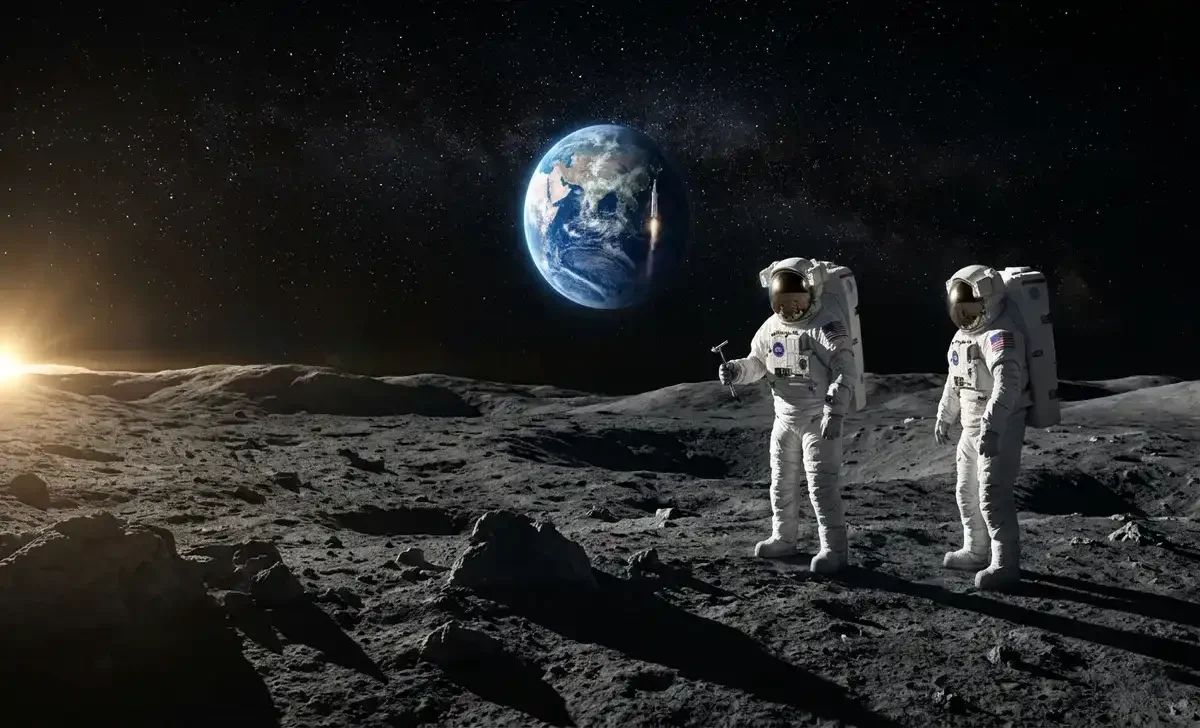
In April 2026, NASA did something no space agency had managed in over fifty years: it sent humans beyond low Earth orbit, around the Moon, and safely home again. The Artemis II mission wasn't a landing — but it was the first real proof that the Artemis program's hardware, after years of delays, cost overruns, and skepticism, actually works with astronauts on board.
That success arrived alongside something else: a major restructuring of the entire Artemis roadmap, announced by NASA Administrator Jared Isaacman just weeks before Artemis II finally launched. The mission that was supposed to land humans on the Moon — Artemis III — will no longer. The landing has been pushed to Artemis IV, targeted for 2028, while Artemis III becomes a rehearsal mission closer to home.
If you've been following headlines about "NASA's Moon mission" and feel like the story keeps changing, that's because it genuinely has. This guide breaks down what actually happened with Artemis II, why NASA reshuffled its plans, what the new roadmap looks like, and what to expect over the next two years — without the recycled trivia you'll find in most explainers.
What Artemis II Actually Did
Artemis II launched on April 1, 2026, from Kennedy Space Center's Launch Complex 39B, carrying four astronauts: commander Reid Wiseman, pilot Victor Glover, mission specialist Christina Koch, and Canadian Space Agency astronaut Jeremy Hansen. The crew named their Orion capsule "Integrity."
The mission's job was straightforward but high-stakes: send the Space Launch System (SLS) rocket and Orion spacecraft around the Moon with people inside for the first time, then bring everyone home safely. Over roughly 10 days, the crew traveled farther from Earth than any humans since Apollo 13 — a useful real-world example of what "Artemis is a rehearsal" actually means in practice. The flight tested life support, navigation, communications, and the Orion heat shield under real crewed conditions, building on the uncrewed Artemis I test flight from November 2022.
The launch itself wasn't smooth sailing to get there. A liquid hydrogen leak and later a helium-flow issue in the rocket's upper stage forced NASA to roll the vehicle back to the Vehicle Assembly Building for repairs, pushing the launch from an original target of February 2026 to April 1. Once it flew, though, the mission went close to plan: the twin solid rocket boosters and four RS-25 engines generated about 8.8 million pounds of thrust at liftoff, and the crew returned safely after a successful flyby.
Why NASA Just Rewrote the Artemis Roadmap
A few weeks before Artemis II finally launched, on February 27, 2026, NASA held a press conference that reshaped the entire program. Administrator Jared Isaacman described the previous plan — which had Artemis III landing astronauts on the Moon — as "not a path to success," citing a pattern of delays and an unsustainable three-year gap between SLS launches.
The core problem NASA was trying to solve: too many new, untested systems were being stacked into single missions. Each Artemis flight was supposed to combine a new rocket configuration, a new spacecraft capability, and new lander hardware all at once — and any one failure could cascade into years of delay, as had just happened with Artemis II's fuel leaks.
The fix is what Isaacman called a "course correction":
- Standardize the SLS architecture. NASA canceled the planned Block 1B and Block 2 upgrades to SLS, including the four-engine Exploration Upper Stage that was meant to debut on a future mission. Instead, NASA will replace the interim cryogenic propulsion stage (the source of Artemis II's helium leak) with a simpler, more proven second stage and stick with a standardized rocket configuration across missions.
- Increase launch cadence. Rather than flying once every three years, NASA wants to get SLS off the pad roughly once a year — eventually aiming for a cadence closer to every 10 months — so that lessons from one flight can quickly inform the next.
- Add a rehearsal mission before the landing. This is the headline change: Artemis III will no longer attempt a Moon landing.
The New Mission Lineup: Artemis III, IV, and V
Here's how the roadmap looks after the February 2026 restructuring:
Artemis III (targeted mid-2027) is now an integrated systems test conducted in Earth orbit and in lunar space, but without a landing. Its job is to practice rendezvous and docking between the Orion spacecraft and the commercial Human Landing Systems being built by SpaceX and Blue Origin. NASA has indicated both companies may get the chance to perform uncrewed landing demonstrations as part of this phase, effectively letting NASA evaluate both vehicles before committing a crew to either one.
Artemis IV (targeted 2028) now carries the distinction that Artemis III used to hold: it's slated to be the first crewed Moon landing since Apollo 17 in 1972, touching down near the lunar south pole. Whichever Human Landing System — SpaceX's Starship or Blue Origin's Blue Origin — is judged ready will be used for the descent and ascent.
Artemis V (also targeted around 2028) would land a second crew on the surface and begin the early infrastructure work for a sustained lunar base, with NASA reportedly preserving the possibility of two landings within the same year.
NASA has framed this less as a single mission and more as a "relay race" — Artemis II proved the rocket and crew vehicle work, and each subsequent flight hands off a piece of the puzzle (lander testing, surface operations, base-building) to the next.
The Hardware Behind the Mission
The Space Launch System (SLS) remains the backbone of every Artemis flight. At about 322 feet tall — taller than the Statue of Liberty — and generating roughly 8.8 million pounds of thrust at liftoff, it produces more power than the Saturn V rockets that carried Apollo astronauts. SLS burns liquid hydrogen and liquid oxygen in its core stage, with two solid rocket boosters derived from the Space Shuttle's design providing most of the initial thrust. Development costs have exceeded $23 billion, which is part of why NASA is now standardizing the design rather than continuing to fund new variants.
The Orion spacecraft, built by Lockheed Martin with a European-built service module from ESA, is the crew capsule. It's designed to support four astronauts for extended deep-space stays, with upgraded life support and radiation shielding compared to the Apollo command module. During re-entry, Orion withstands speeds around 25,000 miles per hour — a figure validated during both the uncrewed Artemis I splashdown in 2022 and the crewed Artemis II return in April 2026.
The Human Landing Systems are where NASA has leaned hardest on commercial partners — a deliberate shift from the Apollo era, where NASA built nearly everything itself. SpaceX's Starship, originally selected in 2021, is being adapted to ferry astronauts between lunar orbit and the surface; Blue Origin's Blue Origin lander, added as a second contractor in 2023, provides a backup and a built-in competitive dynamic. NASA bets that competition between two providers — much like the competitive supply chains that already shape large-scale aerospace manufacturing, as seen in Airbus jet deliveries — will reduce costs and risk compared to relying on a single vendor.
Why Everything Targets the Lunar South Pole
Every crewed Artemis landing — now Artemis IV and V — is aimed at the Moon's south pole, a sharp departure from Apollo's equatorial landing sites. This isn't a cosmetic choice; it's the scientific core of the entire program.
Permanently shadowed craters near the south pole are believed to hold water ice that has accumulated over billions of years. If accessible, that ice could become a source of drinking water, breathable oxygen, and even rocket propellant by splitting water into hydrogen and oxygen — a process known as in-situ resource utilization (ISRU). At the same time, certain ridges near the pole receive near-constant sunlight, making them attractive sites for solar-powered surface operations. The terrain is also geologically ancient and largely unexplored, offering scientists a record of the early solar system that equatorial Apollo sites can't provide.
India's Chandrayaan-3 mission already proved a south pole landing is achievable, touching down in that region in August 2023 — the first spacecraft ever to do so. NASA's robotic missions, including the 2009 LCROSS impact experiment, have separately confirmed water ice exists in these shadowed craters. What Artemis adds is the ability to sample, drill, and test that material with human hands and instruments on-site.
A Crowded Field: International Partners and a New Space Race
The Artemis program is built around the Artemis Accords, a set of principles for peaceful, transparent space exploration. Over 40 countries have signed on, with several playing direct hardware roles: the European Space Agency builds Orion's service module, Japan's JAXA is contributing modules toward a planned lunar space station (the Gateway) and aims to send its own astronauts to the surface, and Canada — whose astronaut Jeremy Hansen flew on Artemis II — is providing robotic systems for future lunar infrastructure.
China and Russia sit outside this coalition entirely, pursuing their own lunar programs. China's robotic Chang'e 7 mission, targeting the lunar south pole, is expected to launch in 2026, alongside testing of China's crewed Mengzhou spacecraft. When asked about the dynamic during the February 2026 briefing, Isaacman said simply that "competition is good" — but the urgency behind NASA's restructuring is clearly shaped by it. China's rapid, state-directed push across strategic sectors — visible in the kind of industrial overcapacity now reshaping global battery manufacturing — is part of the broader backdrop that makes Artemis as much a geopolitical signal as a scientific program.
What Comes After the Moon: The Mars Connection
NASA has never hidden the end goal: everything in Artemis is designed to feed into a future crewed Mars mission, likely in the 2030s or 2040s. The Moon offers a place to test long-duration habitats, refine life support systems away from Earth, study how the human body handles reduced gravity (the Moon's gravity is about one-sixth of Earth's) over weeks or months, and practice using local resources instead of hauling everything from home — a capability that becomes essential when the destination is six months away by spacecraft rather than three days.
That three-day distance is also why the Moon makes sense as a first step: if something goes seriously wrong on a lunar mission, a return to Earth is realistically possible. On Mars, it isn't. Every system Artemis validates close to home is one fewer unknown when the stakes become irreversible.
How to Actually Follow Artemis News Without Getting Lost
Given how often the roadmap has shifted — Artemis II alone slipped from February to April 2026 before launching, and the entire mission order changed weeks before that — following Artemis casually through headlines can be confusing. A few practical habits help:
- Track NASA's official mission pages rather than secondary aggregators. NASA updates its Artemis II and III mission pages directly when timelines or mission profiles change, often before the news cycle catches up.
- Distinguish a "target date" from a launch date. Phrases like "no earlier than" are doing real work — SLS has a history of scrubs and rollbacks, and a delayed target isn't the same as a failed mission.
- Watch for administrator-level announcements, not just launch updates. The biggest changes to Artemis in 2026 didn't come from a launch attempt — they came from a policy and roadmap announcement at a press briefing.
- Use independent forecasting tools as a sanity check. For readers who want a sense of how realistic official timelines are, prediction markets have increasingly been used to crowdsource estimates on everything from launch dates to mission outcomes, offering a useful counterweight to agency optimism.
FAQs
Did Artemis II land on the Moon?
No. Artemis II was a crewed flyby mission. It launched on April 1, 2026, carried four astronauts around the Moon over roughly 10 days, and returned to Earth — but no landing was planned or attempted. The first crewed landing is now targeted for Artemis IV.
Why was Artemis III changed from a landing to a non-landing mission?
NASA's February 2026 program restructuring concluded that combining a new SLS configuration, a new spacecraft capability, and an untested lunar lander into a single mission carried too much risk and had repeatedly caused delays. Artemis III is now an integrated systems test — including rendezvous and docking practice with commercial landers — targeted for mid-2027, with the actual landing moved to Artemis IV in 2028.
Which company will build the lander that takes astronauts to the surface?
Both SpaceX (Starship) and Blue Origin (Blue Origin) hold Human Landing System contracts. NASA has indicated it wants both companies to demonstrate uncrewed landings first and will select whichever vehicle is ready for the Artemis IV crewed landing.
How long will astronauts stay on the Moon once they land?
Plans for the first crewed landing under Artemis IV call for a surface stay of roughly a week, considerably longer than any Apollo mission. Later missions, including Artemis V, are expected to extend surface time further as part of building toward a permanent lunar base.
Is NASA still planning to find or use water ice on the Moon?
Yes. Water ice in permanently shadowed craters near the south pole — already confirmed by missions like LCROSS in 2009 — remains central to Artemis's science goals. Future surface missions aim to sample and test this ice as a potential source of drinking water, oxygen, and rocket fuel.
Why does the Moon program matter if the real goal is Mars?
Because Mars is too far away and too risky to use as a first test bed. The Moon lets NASA validate habitats, life support, and resource-extraction techniques just three days from home, where problems can be caught and fixed before the same hardware is trusted on a mission where turning back isn't an option.