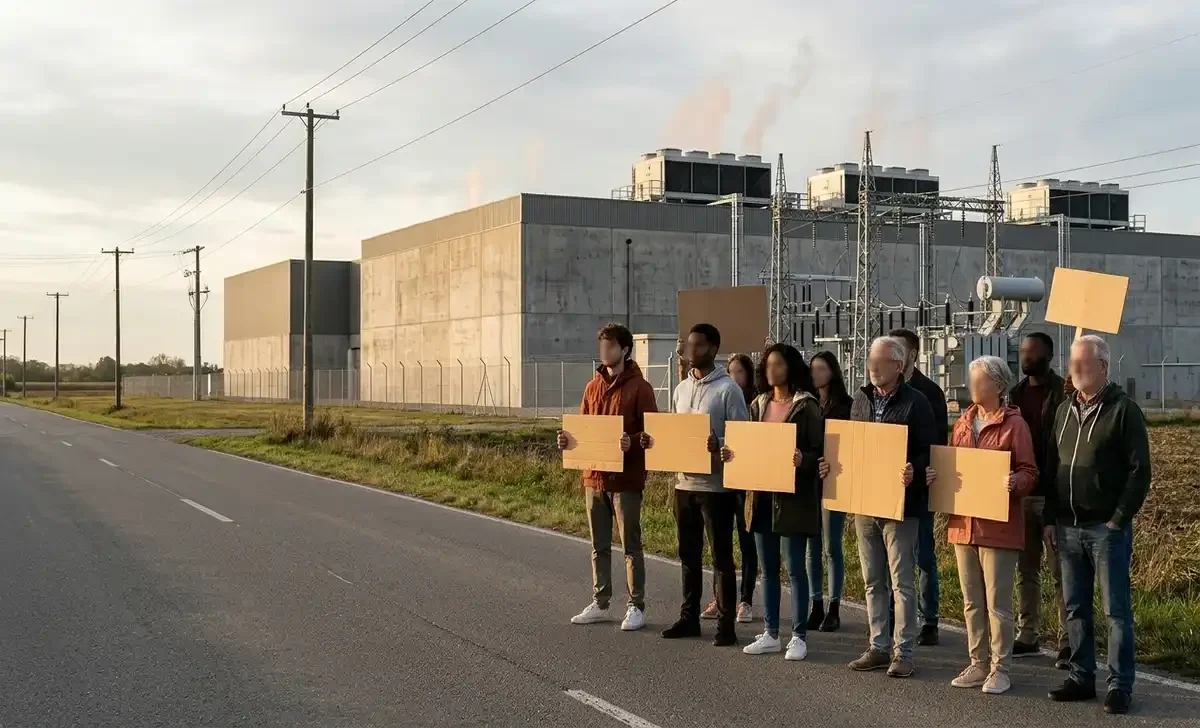
Data centres are going up fast. AI tools, streaming and cloud storage all need huge buildings packed with servers, and tech firms are racing to build more of them.
But the data centre backlash is now hard to ignore. In the United States, Gallup found that about 71% of people opposed AI data centres in their local area by March 2026, up from 47% in late 2025. Residents are packing planning meetings, signing petitions and pushing for pauses.
Their worries are practical: electricity bills, water use, noise and a lack of straight answers. This article explains why opposition is growing, what the evidence says about costs and benefits, and how companies are responding. It also looks at Virginia, the world's busiest data centre market, for lessons other places can use.
Why Is the Data Centre Backlash Growing?
The rapid growth of AI and data centre construction
The building boom is real. ConstructConnect reported record data centre project starts of $25.2 billion in January 2026 alone. Every new chatbot, image tool and cloud service needs more computing power, and that power lives inside these buildings.
Why communities are questioning new developments
What began as scattered local disputes has become a national pattern. Data Center Watch counted at least 75 US projects, worth about $130 billion, blocked or delayed in the first quarter of 2026. Its tally of opposition groups more than doubled in the same period, to over 800 across 49 states.
Lawmakers have noticed. More than 300 state bills on data centres were filed in the first weeks of 2026, and Seattle brought in a one-year pause on several proposed projects. Opposition crosses party lines, which is rare.
The gap between technology companies and local residents
Companies talk about innovation and national competitiveness. Neighbours ask about the hum of cooling fans, the truck traffic and the next electricity bill. Those are two different conversations, and residents often feel nobody is answering theirs.
The Environmental Impact of Data Centres
Rising electricity demand and pressure on power grids
Data centre energy consumption is the biggest worry. A large AI facility can use as much power as a small city, and analysts say demand could double or even triple over the next decade. Utilities must then plan new power plants and grid upgrades.
Some operators are turning to new storage options to ease the strain. Our look at iron batteries for data centres covers one approach.
Water consumption and cooling requirements
Servers get hot, and cooling them can take hundreds of thousands of gallons of water a day at some sites. Data centre water usage becomes a flashpoint in dry regions or places already facing shortages. Cooling systems that use less water often use more electricity, so the trade-off is real.
Noise, emissions and land-use concerns
Cooling fans and backup generators create constant noise and some air pollution. Emerging research suggests data centres often land in communities already dealing with dirty air or water. In Memphis, residents and civic groups challenged air quality around an xAI facility. Large buildings on farmland or near homes and schools add land-use fears on top.
How Data Centres Affect Local Communities
Electricity bills and infrastructure costs
Regulators and consumer advocates have warned that households could end up paying for grid capacity built mainly for hyperscale AI facilities. People notice bills before they notice anything else. A Marquette University Law School poll in Wisconsin found the share of voters who think data centre costs outweigh benefits rose from 55% to 70% in six months.
Local protests and opposition to construction
Data centre protests now happen from small towns to big cities. Peculiar, Missouri, a town of about 3,000 people, was among the first to defeat a project through grassroots pressure, and others have followed its lead. In April 2026, residents in Western Australia marched against a proposed $1.1 billion data centre at Hazelmere, with parents at a nearby school raising concerns about how close it would sit.
Secrecy, public consultation and community trust
Trust breaks down when people hear about a project late. In Linn County, Iowa, Google approached officials before the county had any data centre rules. The county then wrote an ordinance, passed in February 2026. In Hazelmere, critics said the public comment window, March 5 to 20, was too short. Short windows and confidential deals make residents suspect the worst.
The Economic Benefits and Costs of Data Centres
Tax incentives and government subsidies
Governments compete hard for these projects. A CNBC analysis found that 42 US states give data centres full or partial sales tax exemptions, or have no state sales tax at all. Officials say the breaks win investment. Critics say they hand large companies money they do not need.
Local employment, tax revenue and community investment
The benefits are not imaginary. Construction brings work, and local governments can collect property taxes. But once a site is running, it employs relatively few people. Virginia's exemption, for example, requires only 50 new jobs for at least $150 million of investment. That gap between money spent and jobs created fuels doubt.
Who pays for the infrastructure needed to support data centres?
This is the question behind many fights. Power lines, substations and new generation cost billions, and the sector runs on heavy financing. For the wider money picture, see our guide to private credit and economic risk. If companies do not cover their own data centre infrastructure costs, the bill can land on households and local budgets.
Why Technology Companies Are Responding to the Backlash
Promises of greater transparency
Some developers now hold open houses earlier, as happened in St. Charles, Missouri, in August 2026. These meetings help, but residents often say they come after key decisions are already made.
Community funding and financial commitments
In March 2026, seven firms, Amazon, Google, Microsoft, Meta, OpenAI, Oracle and xAI, signed the White House's Ratepayer Protection Pledge. They promised to pay for the new power and grid upgrades their data centres need, and to invest in local hiring and training.
Why some residents remain sceptical
The pledge is voluntary and carries no federal penalty. Reporting notes that how costs will be checked was left unclear, and only parts of it have reached state law so far. Until promises become binding rules, many residents want proof, not press releases.
What the Virginia Data Centre Boom Can Teach Other Communities
How tax incentives helped Virginia attract data centres
Virginia exempts qualifying data centre equipment from state sales tax, and Northern Virginia became the world's largest market. A 2024 state audit by JLARC found the state recovered about 48 cents in new revenue for every dollar of tax it gave up. Other exempted industries averaged just 17 cents.
The trade-off between state tax revenue and local benefits
Still, the cost has grown sharply. Reports put the forgone revenue for fiscal 2025 at between $1.6 billion and $1.9 billion, depending on the measure. Loudoun County residents enjoy lower property taxes thanks to data centre income. Yet Good Jobs First estimated that Hanover County schools lost around $3.6 million in potential state funding.
Lessons for future data centre development
Virginia's 2026 budget kept the exemption but added a tax on data centre electricity use from July 2026 to June 2028, projected at about $600 million a year. That recovers a little over a quarter of the forgone sales tax. The lesson: incentives need regular review, clear conditions and a fair split between state and local benefits.
Can Data Centre Developers Reduce Public Opposition?
Improving public consultation and disclosure
Start early and share numbers: expected power draw, water use, noise levels and job counts. Give people enough time to read and respond. Plain answers, published before votes, build more trust than slogans.
Reducing energy, water and noise impacts
Developers can use cooling designs that cut water use, add noise barriers, place sites away from homes and schools, and bring new power supply rather than lean on the existing grid. Local limits on generators and noise help too.
Ensuring communities receive fair economic benefits
Rules are starting to back this up. Ohio approved a tariff requiring large customers of AEP Ohio to pay at least 85% of contracted capacity for up to 12 years, whether they use it or not. Virginia approved a new rate class for the largest users from January 2027. Communities want binding terms like these, plus real local hiring and investment.
What Does the Future Hold for Data Centre Development?
Expect more pauses, tougher zoning and stricter power-cost rules. Statewide moratorium proposals have already appeared in 14 US states, and AI demand is not slowing. Developers are also chasing steady power sources, including nuclear. Our report on a nuclear site fuelling the AI boom shows how far that search is reaching.
The companies that win will likely be those that earn consent early. In this market, community support is starting to matter as much as land and power.
The Bottom Line
The data centre backlash is not a simple anti-technology feeling. It is a reaction to costs people can see: bills, water, noise and decisions made without them. Tax breaks and thin job numbers make it sharper.
Companies can calm it by sharing real numbers early, cutting local impacts and putting fair cost rules into law. Communities can prepare by reading plans, joining consultations and asking who pays.Frequently Asked Questions About the Data Centre Backlash
Why are people protesting against data centres?
Residents worry about higher electricity bills, heavy water use, noise, air pollution and rushed approvals. Many also feel excluded from decisions and doubt that tax breaks and few permanent jobs deliver enough local benefit.
Do data centres increase electricity bills?
They can, if new power plants and grid upgrades are paid for by all customers. That is why regulators are creating special rates for large users. Outcomes depend on local rules and on who covers the costs.
How much water do data centres consume?
It varies by design and climate. Some sites use hundreds of thousands of gallons a day for cooling. Systems that use less water usually need more electricity, so operators must balance the two.
Do data centres create local jobs?
Yes, mainly during construction. After opening, they employ relatively few staff compared with the investment. Virginia's tax exemption, for instance, requires only 50 new jobs for $150 million or more in spending.
Can communities prevent data centre construction?
Sometimes. Residents have used hearings, zoning changes, petitions, moratoriums and lawsuits to block or delay projects. Peculiar, Missouri, is one early example. Success depends on local law and how early people organise.