A young person finishes school, sends out dozens of applications, and hears nothing back. Every employer wants experience. Nobody offers a way to get it.
That loop is what youth unemployment looks like up close. It is not just a number on a chart. It is a stalled start to adult life, and in many countries it is far too common.
The Netherlands tells a different story. The Dutch system is not perfect, but it is built around one simple idea: a young person should never reach the end of a path with nowhere to go. This article looks at how that idea works in practice, what other countries can learn from it, and where new pressures like AI could test it.
Understanding the Youth Unemployment Challenge
Before comparing countries, it helps to be clear about what we are measuring. The term gets used loosely, and the details matter.
What Is Youth Unemployment?
Youth unemployment refers to people aged roughly 15 to 24 who have no job, are available to work, and are actively looking. Some countries stretch the range to 29.
The rate counts only people in the labor force. A student with no job who isn't looking for one is not counted as unemployed. That is why youth rates can look high even when only a modest share of all young people are job hunting.
Why Young People Struggle to Find Work
The International Labour Organization (ILO) has long reported that young people are about three times more likely to be unemployed than adults. The reasons repeat across countries:
- They have little or no work history.
- They don't yet have the professional networks that lead to referrals.
- They are often the last hired and the first let go when business slows.
- They may not know which jobs exist, or what skills those jobs need.
None of this says young people lack talent or drive. The system is often built in a way that makes the first step the hardest one.
Youth Unemployment vs. Young People Not in Employment, Education or Training (NEET)
These two terms are related but not the same.
The unemployment rate counts jobless young people who are looking for work, as a share of young people in the labor force. The NEET rate counts all young people who are neither working nor studying nor training, as a share of the whole youth population. That includes people who have stopped looking, as well as those who are caring for family or dealing with health problems.
The NEET figure is often the better warning sign. It catches young people who have quietly drifted away from every system that could help them.
Why Youth Unemployment Remains a Global Problem
Rich and poor countries alike struggle with it. The causes differ in size, but the pattern is familiar.
Skills Gaps and the Education-to-Work Transition
Many young people leave school with qualifications that employers don't recognize or can't use. Employers, meanwhile, say they can't find workers with the right skills.
The gap often opens in the handover. School ends on one day. A job search begins the next, with no bridge in between. Countries that treat the move from school to work as a stage that needs its own support tend to do better than those that leave it to chance.
Limited Work Experience and Fewer Entry-Level Jobs
Entry-level roles are the first rung on the ladder. When they shrink, or when employers quietly add experience requirements to them, young people get stuck below the ladder.
A weak economy makes it worse. Firms stop hiring, and school leavers join a long queue behind people who were laid off and have years of experience.
Economic Pressures and Unequal Employment Opportunities
Opportunity is not spread evenly. Young people in poorer regions, those from lower-income families, those with disabilities, and those from migrant backgrounds often face extra barriers. So do young women in many labor markets.
Cost plays a part too. Training and degrees can be expensive, and debt shapes the choices people make. If you want to see how education spending and access connect, our piece on why investment in education matters is a useful starting point.
How the Netherlands Approaches Youth Unemployment
Youth unemployment in the Netherlands has often been among the lowest in the European Union. No single policy explains that. It is the result of several parts working together.
Connecting Education With Employment
Dutch education doesn't treat work as something that begins after school. Students are steered toward a path early, and those paths are linked to real jobs.
At around age 12, children are advised on a secondary school track based on their abilities and interests. Some tracks lead toward university. Others lead toward vocational colleges and skilled work. Each one is meant to be a real route, not a consolation prize.
The Role of Vocational Education and Training
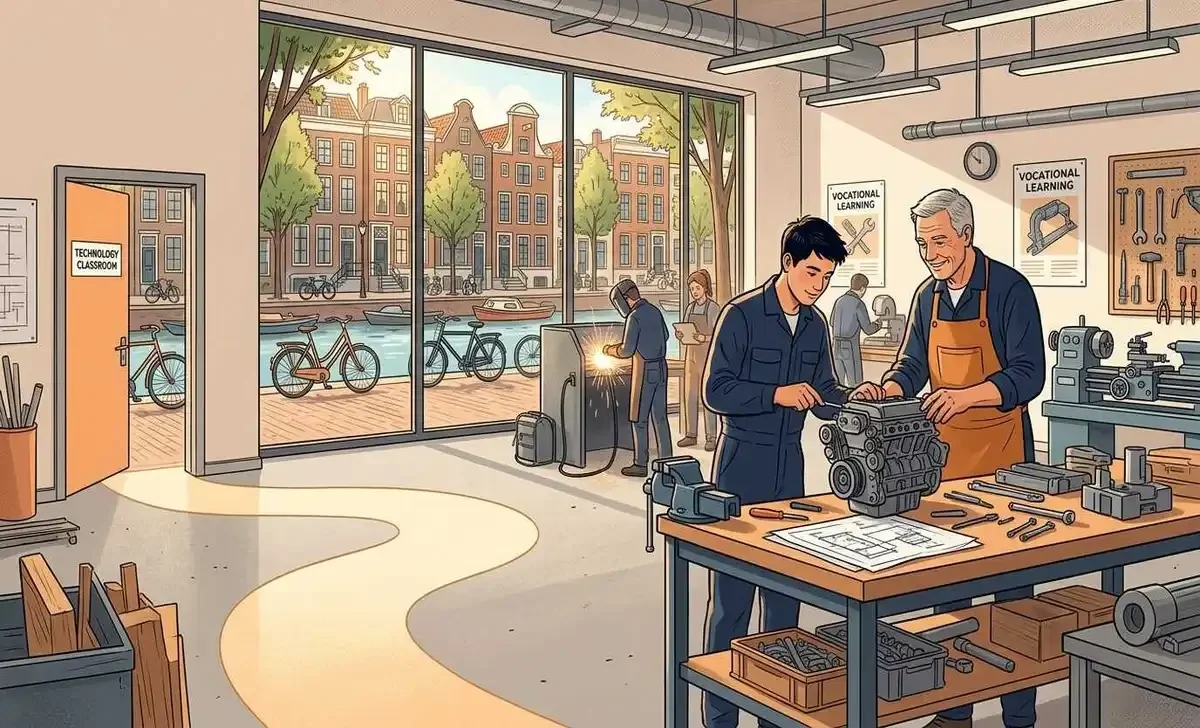
The Dutch vocational system is called MBO. It is a major part of upper secondary and post-secondary education, and a large share of Dutch students choose it.
MBO programs are organized into levels, from basic entry training up to advanced technical and specialist qualifications. Fields include health care, construction, technology, hospitality, business and many more. Higher MBO levels can also lead on to applied universities, so a vocational choice doesn't lock a student out of further study.
That last point matters. When a path keeps doors open, students and parents are more likely to see it as a good choice.
Apprenticeships and Practical Work Experience
MBO students can usually study in one of two ways. In the school-based route, most of the time is spent in the classroom, with work placements built in. In the work-based route, students spend most of the week with an employer and the rest at school, and they typically earn a wage or allowance.
Employers who take on apprentices are accredited, which helps ensure the training is real and not just cheap labor. A national organization that brings together education and business, known as SBB, helps manage that process and links students with training companies.
The outcome is a young person who graduates with a qualification and actual work experience. That solves the experience trap before it starts.
Supporting Young People Who Struggle to Find Work
Not every young person fits neatly into school or a job. The Netherlands has several safeguards for those who don't.
Young people are expected to stay in education until they have a basic qualification or turn 18. If a student drops out, schools report it to a regional office that tries to find them and get them back on track. Municipalities also run youth desks and work with the national employment agency to offer job search help, coaching and training.
The goal is to act while a young person is still connected to the system. That is far easier than reaching someone who has been out of sight for two years.
What Makes the Dutch Approach Different?
Lots of countries have vocational schools and job centers. What stands out in the Netherlands is how the pieces fit together.
Building Clear Pathways From School to Work
A Dutch student can usually see where a path leads. A level, a field, a qualification and a likely job are all connected. Compare that with systems where a young person picks a course and hopes for the best.
Clear pathways reduce guesswork. They also make it easier for employers to understand what a qualification means.
Collaboration Between Schools, Employers and Government
In the Netherlands, employers and unions help shape vocational qualifications. Schools adapt programs to match local needs. Government sets the rules and pays for much of the system.
This shared ownership is the quiet engine of the model. When employers have a say in training, they are more likely to hire the people it produces. Raising student results takes this kind of joined-up effort, as we explore in proven strategies for improving student achievement.
Providing Guidance Before Young People Fall Behind
Early warning is built into the system. Schools track absence and dropout. Career guidance is part of the school experience. Regional services follow up with young people who leave early.
The lesson is timing. Support offered at the first sign of trouble costs less and works better than support offered after a long gap.
Focusing on Sustainable Employment, Not Just Job Placement
Placing someone in any job is not the same as helping them build a career. A short-term job that ends in six months can leave a young person right back where they began.
Dutch policy puts weight on qualifications, because a recognized qualification travels with a person from one employer to the next. It gives them something to stand on if one job ends.
What Other Countries Can Learn From the Netherlands
No country can copy another's system whole. Still, several ideas travel well.
Making Vocational Education a Strong Career Pathway
In many countries, vocational study carries a stigma. Families see it as the second choice, and funding often reflects that.
Changing this takes more than a slogan. It takes quality teaching, modern equipment, strong links to employers, and a clear route to further study for those who want it. When vocational education leads to good jobs and good pay, perceptions follow.
Helping Employers Create Opportunities for Young Workers
Employers are central, yet they are often treated as an afterthought. Governments can make it easier for firms, especially small ones, to take on apprentices. That might mean help with paperwork, support for trainers, or wage subsidies for a limited period.
It also helps to give employers a real voice in designing training, so the skills taught match the skills needed.
Investing in Career Guidance and Early Intervention
Good guidance is cheap compared with long-term unemployment. Young people need honest information about which fields are hiring, what they pay and what training they require.
Early intervention matters just as much. Tracking who is falling out of school or work, and following up quickly, is one of the most practical policies a government can adopt. Early support starts well before the teenage years, a theme explored in our look at the early years education gap.
Adapting Youth Employment Policies to Local Needs
The Netherlands is small, wealthy, densely populated and has strong social partnerships. Those conditions don't exist everywhere.
A country with a large informal economy, or with weak industry, will need a different mix. The useful takeaway is the principle, not the blueprint: connect learning to work, involve employers, and catch young people early. How each country applies it should depend on its own labor market.
New Challenges for Youth Employment
Even well-designed systems face new pressure. Three issues deserve attention.
How Artificial Intelligence Is Changing Entry-Level Jobs
Many entry-level tasks, such as drafting, data entry, basic research and customer support, are the kind of work AI tools can now speed up. Some employers may hire fewer juniors as a result. Others may redesign junior roles to focus on judgment and teamwork.
It is too early to say exactly how this will play out, and anyone who claims certainty is guessing. What we can say is that the first rung of the career ladder is the place to watch.
Preparing Young People for Changing Skills Requirements
If specific tasks change quickly, the answer is not to chase every trend. It is to build strong foundations: reading, writing, numbers, digital confidence, problem solving and the ability to keep learning.
Practical training helps here too. People who learn on the job pick up habits that are harder to teach in a classroom, like working with others and handling feedback. Skills also depend on access to higher education, a link we explore in higher education and democracy.
Addressing Insecure Work and Long-Term Unemployment
A job is not always a good job. Many young workers are on temporary or irregular contracts, with little security and few chances to train. Long stretches without work can also leave marks, from lower future earnings to lost confidence.
Decent work means fair pay, reasonable stability, safe conditions and room to grow. Policies that only count jobs, without checking their quality, can miss this.
Building a Future With No Dead Ends
The phrase "no dead ends" captures the Dutch idea well. Every route should lead somewhere, and a setback should not mean the end of the road.
The Role of Governments, Employers and Educators
Each group has a job to do:
- Governments set the framework, fund training and guidance, and track those at risk of dropping out.
- Employers offer apprenticeships, entry-level roles and real feedback on the skills they need.
- Educators keep programs current, teach practical skills and help students see their options.
When one group steps back, the others can't fill the gap. The system works because all three stay involved.
Creating More Inclusive and Sustainable Employment Opportunities
Inclusion has to be designed in. That means reaching young people with disabilities, those from low-income homes, those in rural areas and those who have left school early. It also means asking whether the jobs created are secure enough to build a life on.
The price of getting this wrong is high, as is the benefit of getting it right. Education that opens real doors is worth the investment, as explored in our article on why MBA tuition keeps rising and what rising costs mean for access.
The Dutch model offers a clear takeaway. Young people do better when learning and work are connected, when employers share responsibility, and when someone notices early if a young person is slipping away. Any country can start with those three habits.
What to Do Next
If you work in education, business or policy, pick one gap in your own area. It could be an apprenticeship that doesn't exist yet, a guidance service that starts too late, or a group of young people nobody is tracking. Then ask who needs to be at the table to close it.
Frequently Asked Questions About Youth Unemployment
What Are the Main Causes of Youth Unemployment?
The most common causes are limited work experience, a mismatch between skills and job needs, weak economic growth, fewer entry-level jobs and unequal access to opportunity. Insecure hiring practices and poor career guidance can add to the problem.
How Does the Netherlands Tackle Youth Unemployment?
The Netherlands combines early career guidance, a strong vocational education system, apprenticeships with real employers, and tracking of students who leave school early. Schools, employers and government work together, and municipalities offer support to young people who are looking for work.
Can Vocational Education Help Reduce Youth Unemployment?
Yes, when it is high quality and tied to real jobs. Programs that include work placements and are designed with employers tend to give graduates both a qualification and experience. Vocational education works best when it also keeps the door open to further study.
What Can Other Countries Learn From the Dutch Approach?
The main lessons are to build clear pathways from school to work, involve employers in training, offer guidance early and act quickly when young people drop out. Each country will need to adjust these ideas to fit its own economy and institutions.
How Can Governments Help Young People Find Decent Work?
Governments can fund training and apprenticeships, support employers who hire young workers, invest in career guidance, protect young workers from exploitative contracts and monitor those at risk of disengaging. Measuring job quality, not just job numbers, also helps.